Taking stock of budget advocacy efforts in Eastern Europe, South-Eastern Europe and Central Asiа

We are happy to present the mapping report „Taking stock of budget advocacy efforts in Eastern Europe, South-Eastern Europe and Central Asiа“ summarising budget advocacy efforts, funding and impact during the period 2018-2021 in CEECA countries.  The focus of the assessment is on the role of civil society in budget advocacy, while acknowledging that government leaders, UN and technical partners play important roles as well. The assessment describes key budget advocacy initiatives and HIV donor support for them. The report zooms in the four result areas of advocacy: civil society capacity to advocate; influencing HIV funding levels from national and local public sources; increasing efficiencies in spending; and contracting and funding for NGOs to deliver services. Without offering a comprehensive review, one of the final sections of the report shines light on efforts to influence budgets beyond HIV including in the fields of TB and health systems.

Regional overview is based on eight country case studies exploring national experiences with budget advocacy, emerging challenges, and best practices. Kyrgyzstan, Moldova and Ukraine (lower middle-income countries), Georgia, Kazakhstan and Montenegro (upper middle income countries receiving donor support), and Bulgaria and North Macedonia (post-Global Fund countries) were selected for analysis.

To keep the mapping manageable and focused, this assessment has not attempted to assess neither the impact of the ongoing COVID-19 pandemic on HIV budget advocacy and fiscal space for health financing nor potential savings from reducing criminalization of population behaviours.

Analytical report «Taking stock of budget advocacy efforts in Eastern Europe, South-Eastern Europe and Central Asiа» has been prepared by EHRA in partnership with Open Society Foundations, The Global Fund to Fight AIDS, Tuberculosis and Malaria Sustainability, Transition and Efficiency Strategic Initiative and EECA regional team in cooperation with ECOM – Eurasian Coalition on Health, Rights, Gender and Sexual Diversity and Eurasian Women’s Network on AIDS (EWNA) as partners in the Eurasian Regional Consortium withing project “Thinking outside the box: overcoming challenges in community advocacy for sustainable and high-quality HIV services” supported by the Robert Carr Fund for civil society networks. Information was provided by country, regional and international partners. We are grateful to all our partners, members of Regional Advisory Group on Sustainability, interviewees and reviewers for their time and effort in work on this report.
Taking stock of budget advocacy efforts in Eastern Europe, South-Eastern Europe and Central Asiа. Full report

REQUEST FOR PROPOSALS: a consultant to conduct community-based assessment on drug scene and drug use patterns changes during Covid-19 in CEECA region

RFP Number EHRA-01-06
RFP Title Сonsultancy. Assessment on drug scene changes during Covid-19
RFP Closing Date and time : 23:59 EET, 14 February 2022
Proposal Submission Address: info@harmreductioneurasia.org

Background

Eurasian Harm Reduction Association (EHRA) is a non-for-profit public membership-based organization uniting harm reduction activists and organisations from Central and Eastern Europe and Central Asia (CEECA) with its mission to actively unite and support communities and civil societies to ensure the rights and freedoms, health, and well-being of people who use psychoactive substances in the CEECA region.

Covid-19 pandemic affected not only provision of harm reduction and other health and social services worldwide, but also made an influence on drug scene and drug use patterns changes. Anecdotal data in CEECA region shows that more new psychoactive substances, and/ or substances which were not before accessible there, entered the drug markets[1]. EHRA as a part of the RCF Covid-19 Grant Relief project is looking for a consultant to conduct community-based[2] assessment on drug scene and drug use patterns changes during Covid-19 in CEECA region.

Objectives of the consultancy:

  • To develop methodology for the community-based assessment in consultation and agreement with EHRA. The current vision of methodology includes desk research and collection of data through the online questionnaires, however it is not limited to the before mentioned activities.
  • To collect data for the report. We expect consultant to collect data from at least 200 people in 28 countries[3] of CEECA region (number of questionnaires per country will be agreed while signing the agreement with selected consultant).
  • To process data for the preparation of report.
  • To develop a regional report on drug scene and drug use patterns changes during Covid-19 in CEECA region. Report should be written in English or Russian language and not exceed 30 pages.

Only consultants who are fluent and understand both – Russian and English can apply.

Assessment should analyze, but is not limited to the following questions, which will be discussed with a selected consultant during preparatory work:

  • What drugs people used before Covid-19 and did their drug of choice changed during pandemic? What is their new drug of choice?
  • What was the reason that people switched to other drugs during Covid-19?
  • Did the administration route of drugs change?
  • Did the method of purchasing of drugs change?
  • If there is seen an increase of overdoses during Covid-19?
  • How the prices of drugs changed?
  • Are people facing any mental health issues during Covid-19? What are the issues and what actions are taken to respond to it?
  • Are people facing any challenges in receiving health, social and legal support during Covid-19?

!!! Please, notice that assessment should be conducted online. There is no available budget for consultant to travel to countries. EHRA will support consultant to connect with national partners, however, we expect consultant to have at least minimal connection with partners from CEECA region.

Proposed timeline:

  • Methodology for the community-based assessment should be prepared and agreed with EHRA by 21st March, 2022.
  • Data in 28 countries of CEECA region should be collected by 2nd May, 2022.
  • 1st draft of the report should be developed and send to EHRA for a feedback by 23rd May, 2022.
  • Final version of the report should be ready by 6th June, 2022.

Evaluation Criteria

Submitted applications will be evaluated by the evaluation panel of the Eurasian Harm Reduction Association.

A two-stage procedure will be utilized in evaluating the proposals:

  • evaluation of the previous experience (portfolio) via technical criteria – 80% in total evaluation;
  • comparison of the costs (best value for money) – 20% in total evaluation.

Cost evaluation is only undertaken for technical submissions that score a minimum 80 points out of a maximum of 100 as a requirement to pass the technical evaluation. A proposal that fails to achieve the minimum technical threshold will not be considered further.


To assess submitted applications, the following technical criteria will be used (80%) (maximum possible number of points is 100):

Сriteria: Points
Relevant experience in developing methodologies for the researches/ assessments/ studies 30
Relevant experience in collecting and analyzing data for the research 40
Experience in developing regional reports, and/ or reports, which are comparing few countries 30
Maximum possible number of points 100

Cost proposal (20%): EHRA will allocate same importance to the provided portfolio and recorded experience as to the cost of the services. The cost proposal will be evaluated in terms of best value-for money to EHRA in EUR, price and other factors considered

Condition

  • Only consultants who are fluent and understand both – Russian and English are eligible to apply.
  • This announcement and its attachments shall not be construed as a contract or a commitment of any kind. This request for proposals in no way obligates EHRA to award a contract, nor does it commit EHRA to pay any cost incurred in the preparation and submission of the proposals.

How to apply

To be eligible as a EHRA consultant, any organization or individual must comply with the Eurasian Harm Reduction Association Code of Ethics which you can find at the following link: https://old.harmreductioneurasia.org/ehra-code-of-ethics/

Applicants must submit the following documents:

– CV,

– Letter of Interest. The CV and application should clearly reflect the competency of the candidate necessary to complete this task, as well as include the proposed number of working days for each stage, daily rate in EUR and timing of their implementation.

Please submit your proposal to info@harmreductioneurasia.org.

In the subject line of your e-mail please indicate the RFP number, title “Consultancy. Assessment on drug scene changes during Covid-19”.  Otherwise, the application will not be considered.

General terms

Interested consultants should pay attention to the following conditions:

  • EHRA will sign an agreement with the winner of the competitive selection. The contract will define a detailed work plan and payment terms.
  • EHRA reserves the right (but does not commit itself to obligations) to enter into negotiations with one or more applicants in order to obtain clarifications or additional information, as well as to agree on the timing of work.
  • The winner must confirm his/her daily rate before signing of the agreement.
  • Results will be announced by 15th February 2022. Each candidate will be contacted individually.
  • Any questions regarding the participation should be sent to eliza@harmreductioneurasia.org till 10th February, 2022.

[1] https://old.harmreductioneurasia.org/wp-content/uploads/2020/06/regional-review_-FINAL_ENG_1.pdf

[2] We expect consultant to involve community representatives into the development of the methodology and participation in the assessment.

[3] Albania, Armenia, Azerbaijan, Belarus, Bosnia and Herzegovina, Bulgaria, Croatia, Czechia, Estonia, Georgia, Hungary, Kazakhstan, Kosovo, Kyrgyzstan, Latvia, Lithuania, Moldova, Montenegro, North Macedonia, Poland, Romania, Russia, Serbia, Slovakia, Slovenia, Tajikistan, Ukraine, Uzbekistan.

REQUEST FOR PROPOSALS: EHRA is pleased to announce a new RFP on Selection of simultaneous interpreters

RFP Number EHRA-01-03
RFP Title External consultant. Simultaneous interpreters
RFP Closing Date and time: 24:00 EET on January 31, 2022
Proposal Submission Address: info@harmreductioneurasia.org

Background

Eurasian Harm Reduction Association (EHRA) is a non-for-profit public membership-based organization uniting harm reduction activists and organisations from Central and Eastern Europe and Central Asia (CEECA) with its mission to actively unite and support communities and civil societies to ensure the rights and freedoms, health, and well-being of people who use psychoactive substances in the CEECA region.

More information about the Association and specifics of the work you can find on our website: https://old.harmreductioneurasia.org

Objectives of the tender:

EHRA announces a tender for the selection of simultaneous interpreters from English into Russian and from Russian into English for long-term cooperation (remote online work). Based on the results of the tender, several simultaneous interpreters will be selected, with whom EHRA will sign long-term contracts.

Evaluation criteria:

Submitted applications will be evaluated by the evaluation panel of the Eurasian Harm Reduction Association.

A two-stage procedure will be utilized in evaluating the proposals:

  • evaluation of the previous experience (portfolio) via technical criteria – 80% in total evaluation;
  • comparison of the costs (per-hour cost in EUR) – 20% in total evaluation.

Cost evaluation is only undertaken for technical submissions that score a minimum 80 points out of a maximum of 100 as a requirement to pass the technical evaluation. A proposal which fails to achieve the minimum technical threshold will not be considered further.


 To assess submitted applications, the following technical criteria will be used (80%) (maximum possible number of points is 100): Points
Simultaneous interpretation experience in public health and human rights, harm reduction, drug policy, response to the HIV epidemic (at least 1 year) 50
Academic background (degree in linguistics, philology, etc., special courses for interpreters, certificates, etc.) 50
Maximum possible number of points 100

Cost proposal (20%): EHRA will allocate same importance to the provided portfolio and recorded experience as to the cost of the services. The cost proposal will be evaluated in terms of best value-for money (per hour cost in EUR working remotely online).

How to apply

To be eligible as an EHRA consultant, any organization or individual must comply with the Eurasian Harm Reduction Association Code of Ethics which you can find at the following link: https://old.harmreductioneurasia.org/ehra-code-of-ethics/

Applicants must submit the following documents:

  1. CV with relevant information in the field of simultaneous interpretation and education.
  2. Application (motivation letter) in free form, in which you must specify:

–   cost per hour in EUR of remote work online;

–  the subject matter in which you are working, taking into account the specifics of EHRA, especially highlighting services for UN agencies or the Global Fund, services to combat HIV, TB and malaria;

–  contact details of persons for whom you have provided interpretation services in the last 6 months (2-3 events).

Please submit your proposal to info@harmreductioneurasia.org .

In the subject line of your e-mail please indicate the RFP number EHRA-01-03, the title “External consultant. Simultaneous interpreters” and your name. Otherwise, the application will not be considered.

ATTENTION. If these documents are not submitted in full, the participant will not be allowed to take part in the tender.

General terms

Interested consultants should pay attention to the following conditions:

  • This RFP shall not be interpreted as a contract or obligation of any kind. This invitation to tender does not in any way oblige EHRA to enter into contracts, nor does it oblige EHRA to pay any costs incurred in preparing and submitting applications.
  • Participants must confirm that the cost of the works specified in the application are valid for a period of at least 24 months from the date of the competition.
  • During the evaluation period, EHRA reserves the right to ask candidates to complete an additional task in the form of simultaneous interpretation.
  • Based on the results of the tender, a contract for the provision of services for a two-year period will be signed with the winners. The contract is not an employment contract. Payment of all taxes and social insurance is the responsibility of the contractor. Further work will be carried out in accordance with the request of EHRA, which will indicate the timing and other specific conditions.

Webinar on police response to GBV toward women using drugs

On December 16, 2021 EHRA hosted webinar for law enforcement representatives  on police response to domestic/ intimate partner violence among women who use drugs. The aim of the webinar was to build capacity and knowledge about effective police approaches in provision of help and protection to women using drugs in case of domestic and intimate partner violence. The webinar was attended by police representatives from Ukraine, Belarus, Moldova, Romania, Kazakhstan, Lithuania, Belgium, Russian Federation, Serbia, Estonia.

HIG bby Plotko cover
Help impossible to ignore: basic needs and barriers in access to health and social care services and shelters in case of violence for women using drugs in the EECA region, by Maria Plotko
Police services provision, part of a multi-sectoral response to GBV. Standard Operating Procedures
Building bridges cover
Building bridges between survivor and provider, by Ionela Horga
Policing domestic violence. Belgian approach
Department of Human Rights. National Police of Ukraine

EXTENDED. Request for Proposals: Grants to support the community-led activities focused on ensuring the sustainability of HIV / TB responses among KAPs within the transition from the Global Fund’s support to national funding in Republic of Armenia and Republic of Kosovo

Eurasian Harm Reduction Association (EHRA) invites initiative groups, organizations of communities of people living with or affected by HIV and TB, as well as non-governmental HIV and TB focused organizations being involved in the implementation of Global Fund grants at the national level in the Republic of Armenia and Republic of Kosovo, to apply for grants to support the community-led activities focused on ensuring the sustainability of HIV / TB responses among KAPs within the transition from the Global Fund’s support to national funding in these countries.

The proposed project activities must address the problem(s) prioritized by one or several key affected communities and fit one of the next priority areas for support:

∙ Community led monitoring of the relevant transition related process;

∙ Coordination/consolidation of different community efforts in watchdogging of the transitioning processes and advocacy;

∙ Community led advocacy focused on ensuring the sustainability of HIV/TB response among KAPs within the transition.

Period of implementation: January – July 2022

No more than 2 grants will be awarded (1 grant per country) for the period up to 6 months of implementation. The budget limit for each grant is US $ 6,500.

Deadline to apply: 23rd of December 2021 23:59 CET

For more details please read the Request for Proposals (RFP).

Application Form.

Work plan and Budget Template.

Announcement of the winners of media materials contest about the life and problems of people who use psychoactive substances

The Eurasian Harm Reduction Association (EHRA) has held a contest of media materials about the life and problems of people who use psychoactive substances.

The task of the competition was to create and place in media or social media a material (article / post / video / program / podcast / investigation / interview, etc.), highlighting the problem of stigma, discrimination or criminalization of people who use psychoactive substances in one of the cities or countries of the region.

The competition was held in four categories: print media (newspapers / magazines / websites), TV (including online TV and vlogs), radio and social networks. In total, 21 materials were received from 7 countries (Georgia, Kyrgyzstan, Moldova, Russia, Slovakia, Ukraine, Uzbekistan).

Winners by category:

print media (newspapers / magazines / websites)

I place – Olesya Bida (Ukraine)

Material in Russia:

https://hromadske.ua/ru/posts/ty-eshe-ne-gotov-ot-nas-ujti-kak-reabilitacionnye-centry-dlya-narkozavisimyh-lechat-lomayut-i-krepko-uderzhivayut

Material in Ukrainian:

https://hromadske.ua/posts/ti-she-ne-gotovij-vid-nas-piti-yak-reabilitacijni-centri-dlya-narkozalezhnih-likuyut-lamayut-i-micno-trimayut

II place – Elena Derzhanskaya (Moldova)

Materials:

  1. https://life4me.plus/ru/news/espch-mayer-protiv-moldovyi-7724/
  2. https://life4me.plus/ru/blog/moldova-narkozavisimost-7809/
  3. https://life4me.plus/ru/blog/moldova-beltsyi-snizhenie-vreda-7754/

III place – Olga Efimenko (Ukraine)

https://www.motilek.com.ua/motylyok-70/#more-9833  (page 6)

III place – Anastasia Bengard (Kyrgyzstan)

https://24.kg/obschestvo/208769_novyie_narkotiki_trebuyut_drugih_podhodov_ili_estli_jizn_posle_zavisimosti/


TV (including online TV and vlogs)

I place – Anna Chabanenko (Ukraine)

https://ukraine-inform.com/video-derzhava-uryad/100967-real-narkopol-tiki-v-ukra-n-chomu-narkozalezhn-opinyayut-sya-za-ratami.html


Radio

I place – Alina Sarnatskaya (Ukraine)

  1. https://cutt.ly/4Ex5UY4
  2. https://podcasts.nv.ua/ukr/episode/4818.html

II place – Evgenij Lesnoj (Ukraine)

  1. http://www.nrcu.gov.ua/schedule/play-archive.html?periodItemID=2935113
  2. http://www.nrcu.gov.ua/schedule/play-archive.html?periodItemID=2935358


Social media

I place – Alexander Levin (Russia)

https://www.youtube.com/watch?v=wfH_rZ-S1Vg

I place – Jakub Popik (Slovakia)

https://podcasts.apple.com/us/podcast/triezva-drogov%C3%A1-politika/id1569556596?id=1569556596&ign-mpt=uo%3D4

II place – Andrey Pavlov (Russia)

https://drugvoice.simplecast.com

III place – Irma Kahurashvili (Georgia)

https://bit.ly/3ul0W60


Thanks to all who participated and congratulations to the winners!

Request for Proposals: Grants to support the community-led activities focused on ensuring the sustainability of HIV / TB responses among KAPs within the transition from the Global Fund’s support to national funding in Republic of Armenia and Republic of Kosovo

Eurasian Harm Reduction Association (EHRA) invites initiative groups, organizations of communities of people living with or affected by HIV and TB, as well as non-governmental HIV and TB focused organizations being involved in the implementation of Global Fund grants at the national level in the Republic of Armenia and Republic of Kosovo, to apply for grants to support the community-led activities focused on ensuring the sustainability of HIV / TB responses among KAPs within the transition from the Global Fund’s support to national funding in these countries.

The proposed project activities must address the problem(s) prioritized by one or several key affected communities and fit one of the next priority areas for support:

∙ Community led monitoring of the relevant transition related process;

∙ Coordination/consolidation of different community efforts in watchdogging of the transitioning processes and advocacy;

∙ Community led advocacy focused on ensuring the sustainability of HIV/TB response among KAPs within the transition.

Period of implementation: January – July 2022

No more than 2 grants will be awarded (1 grant per country) for the period up to 6 months of implementation. The budget limit for each grant is US $ 6,500.

Deadline to apply: 15th of December 2021 23:59 CET

For more details please read the Request for Proposals (RFP).

Application Form.

Work plan and Budget Template.

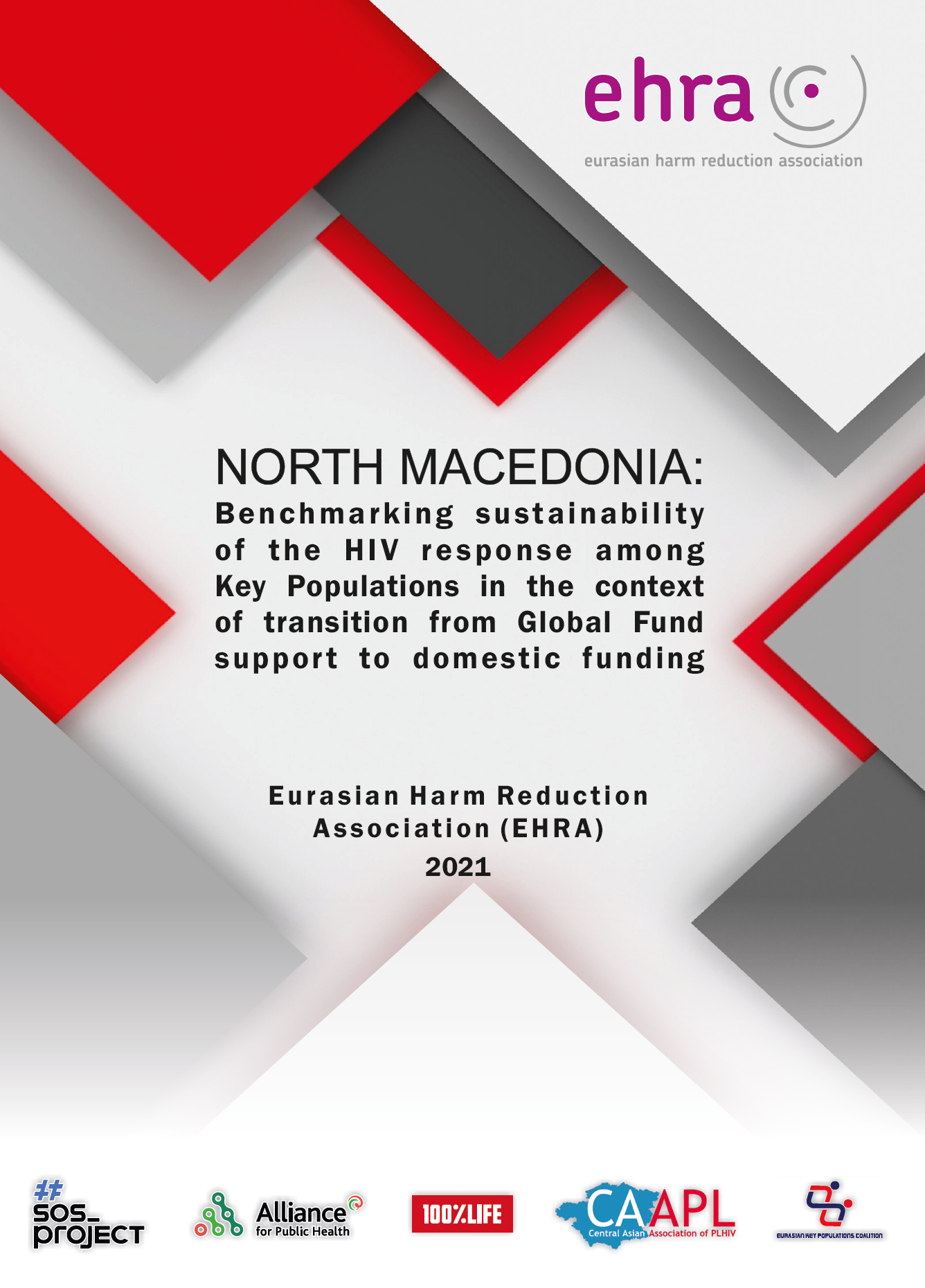
North Macedonia: Benchmarking sustainability of the HIV response among Key Populations in the context of transition from Global Fund support to domestic funding

This assessment of the fulfillment of key public commitments with respect to the sustainability of the HIV response among key populations in the context of transition from Global Fund to domestic funding in North Macedonia was conducted using the Methodological Guide and Transition Monitoring Tool (TMT) developed by EHRA. A number of national commitments contributing to ensuring sustainability of the HIV response were identified and prioritised and subsequently analysed based on available data, as well as information from key informants. The assessment was conducted and led by two national reviewers with the support of local HIV experts and representatives of affected communities from organisations involved in advocacy and service delivery for KAPs and PLHIV (the national reference group).

With regards to the fulfillment of the prioritised transition and sustainability-related commitments that were the subject of the analysis, North Macedonia appears to have demonstrated substantial progress in two key domains – financing (progress score of 80%) and service provision (73%); average progress in the domains of data and information (63%) and human resources (55%); moderate progress in governance (43%); and low progress in the domain of drugs, supplies and equipment (0%).

Progress in the fulfillment of the selected transition-related commitments by health system domains in North Macedonia

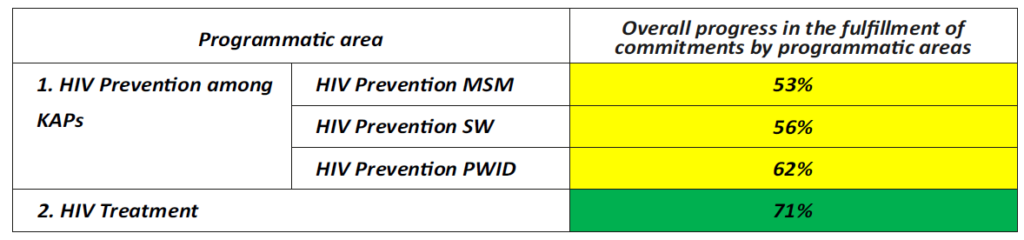
From the point of view of programmatic areas, substantial progress in fulfilling the selected transition and sustainability-related commitments was observed in the area of HIV treatment (progress score of 71%), while average progress was achieved in the area of HIV prevention among KAPs (progress scores of 53% for MSM, 56% for SWs and 62% for PWID).

Progress in the fulfillment of the selected transition-related commitments by programmatic areas

This document should be used to assist CSO’s, key affected communities and partners to remain more informed and engaged in the monitoring of the transition process from donor to domestic funding and to thereby advocate for the implementation of activities that will lead to the sustainability of the national HIV response

See the Report

The Global Drug Policy Index: PRESS RELEASE FOR Central and Eastern Europe and Central Asia (CEECA) region

Most countries fail drug policy test according to new Index globally and in CEECA region

First-ever accountability tool assesses and ranks countries’ drug policies against key UN-system recommendations

Tuesday, November 16, 2021 (Vilnius, Lithuania) — Norway, New Zealand, Portugal, the UK and Australia are the five leading countries on humane and health driven drug policies according to the inaugural edition of the Global Drug Policy Index released today by the Harm Reduction Consortium. Brazil, Uganda, Indonesia, Kenya, and Mexico are the five lowest-ranking countries.

However, Norway, despite topping the Index, still only managed a score of 74/100. And the median score across all 30 countries and dimensions is just 48/100.

“48 out of 100 is a drug policy fail in anyone’s book,’ said Ann Fordham, Executive Director of the International Drug Policy Consortium which led on the development of the Index with the partners in the Harm Reduction Consortium.

“None of the countries assessed should feel good about their score on drug policy, because no country has reached a perfect score. Or anywhere near it. This Index highlights the huge room for improvement across the board.”

For decades, tracking how well – or badly – governments are doing in drug policy has been an elusive endeavour. In no small part, this is because data collection efforts by both governments and the UN have been driven by the outdated and harmful political goal of achieving a ‘drug-free society.’

Most governments continue to employ a repressive approach to drug control based on this skewed data, which in turns means they cannot be held accountable for the damage their policies inflict on the lives of so many people.

The success of drug policies has not been measured against health, development, and human rights outcomes, but instead has tended to prioritise indicators such as the numbers of people arrested or imprisoned for drug offences, the amount of drugs seized, or the number of hectares of drug crops eradicated.

The Global Drug Policy Index is the first-ever data-driven global analysis of drug policies and their implementation. It is composed of 75 indicators running across five broad dimensions of drug policy: criminal justice, extreme responses, health and harm reduction, access to internationally controlled medicines, and development.

“The Global Drug Policy Index is nothing short of a radical innovation,’ said Helen Clark, Chair of the Global Commission on Drug Policy and former Prime Minister of New Zealand.

“Good, accurate data is power, and it can help us end the `war on drugs´ sooner rather than later.”

“What’s clear from the results is that no government can be complacent,” said Julita Lemgruber, former Director of the Prison System of the State of Rio de Janeiro. “Even in the highest-ranking countries, progress is sorely needed. Governments worldwide must abandon the idea of drug policies as instruments of “war” and understand them as means to promote human rights and citizenship.”

Across the CEECA region, the five countries examined in this first version of the Index – Georgia (55/100), Hungary (50/100), Kyrgyzstan (50/100), North Macedonia (55/100) the Russian Federation (41/1100) – have all scored low. The goal of 100/100 is a minimum standard for an effective health response to drugs.

„The Index will be expanded in the future to other countries of the region, but the picture already is clearly one of disproportionate criminal justice responses, inequitable application of drug laws, and a lack of access to both harm reduction and medicines for pain control and palliative care. Compared to the United Nations standards and recommendations, this is not good enough” – summarising the situation in the region prof. Michel Kazatchkine and Pavel Bem, members of the Global Commission on Drug Policy from CEECA region.

The Index’s first iteration evaluates the performance of 30 countries covering all regions of the world and is illustrated by real life stories, including of people who use drugs, from around the world.

The Index’s results reflect that:

  • The militarised and law enforcement approach to drug control continues to prevail: Some level of lethal use of force by military or police forces was reported in half of the countries surveyed, with widespread cases in Mexico and Brazil.
  • The disproportionate impact of drug control on marginalised people on the basis of gender, ethnicity and socio-economic status was reported to some extent across all dimensions, and across all countries.
  • Drug law enforcement targets primarily nonviolent offences, and especially people who use drugs: Only 8 out of the 30 countries surveyed have decriminalised drug use and possession, and out of those, only 3 managed to truly divert people away from the criminal justice system.
  • The funding gap for harm reduction remains highly concerning: Only 5 out of 30 countries have allocated ‘adequate’ funding to harm reduction, and of those countries, funding is considered secure in only one (Norway).
  • There is a huge gap between government policies and their implementation on ensuring access to controlled medicines, especially in countries like India, Indonesia, Mexico, and Senegal which score high on policy, but score 0/100 for actual availability for those in need.
  • Alternative development programmes in areas of illegal cultivation remains entrenched in interdiction and eradication, with Colombia scoring particularly low (23/100) due to its militarised strategy focusing on forced eradication and the harmful use of aerial spraying.

____

NOTES TO THE EDITOR

  • The results of the Global Drug Policy Index 2021, including its companion analytical report and real-life stories of individuals’ experiences with drug policies from across the globe, will be available on Monday November 8 through an interactive web-tool accessible through this link: globaldrugpolicyindex.net
  • The Global Drug Policy Index is a project of the Harm Reduction Consortium, which includes the following partners: the European Network of People Who Use Drugs (EuroNPUD), the Eurasian Harm Reduction Association (EHRA), the Eurasian Network of People who Use Drugs (ENPUD), the Global Drug Policy Observatory (GDPO) / Swansea University, Harm Reduction International (HRI), the International Drug Policy Consortium (IDPC), the Middle East and North Africa Harm Reduction Association (MENAHRA), the West African Drug Policy Network (WADPN), the Women and Harm Reduction International Network (WHRIN), and Youth RISE.

Download this page as pdf document