EXTENDED: EHRA is looking for consultants to develop an interactive online training course on digital services

EHRA is looking for the consultants to develop an interactive online training course on digital services for key population groups that are vulnerable to HIV, including people who use drugs, men who have sex with men, trans* people and women living with HIV.

The new deadline for submission is before 24:00 EET on May 31, 2021.

Eurasian Harm Reduction Association  (EHRA) as part of the Eurasian Regional Consortium’s project “Thinking outside the box: overcoming challenges in community advocacy for sustainable and high-quality HIV services” supported by the Robert Carr Fund for civil society networks (RCF) is looking for qualified providers to develop and conduct an interactive online training course on digital services for key populations (people who use drugs, men who have sex with men, trans people and women living with HIV).

Tasks under this tender

The purpose of the course is to build capacities of peer workers, social workers, psychologists and other specialists who are involved in provision of online/remote services and managers of those programs for a better quality of those services. The course should take into account the information, conclusions, and recommendations provided in THIS technical draft[1] of the executive summary of the Report on Mapping Digital and Remote Healthcare-Social HIV Services for Key Populations in countries of Central, Eastern Europe and Central Asia.

  1. Develop and produce interactive online training course allowing potential users to progress in an engaging virtual learning environment. Course content and delivery should be designed in a way that participants can complete the course 90% independently. 10% of the course should include mentoring, supervision or coaching support.

The course should contain the following thematic blocks:

  • role and specifics of digital services in package of services for key populations;
  • planning and management of digital services;
  • practical skills building to improve provision of quality services;
  • safety and confidentiality (for both client and consultant);
  • ethics of consultant-client relationship in an online environment.
  1. Place the content of the course to existing online course platform: https://ehra.learnworlds.com/home.
  2. Pilot the course and, based on the results of the pilot (feedback from the participants and EHRA), make necessary changes in course design and content.
  3. Produce scripts/guidelines for mentors and trainers of the course.

All course materials should be available in Russian and English.

[1] https://harmreductioneurasia-my.sharepoint.com/:w:/g/personal/igor_harmreductioneurasia_org/ERGwxX-JzBdGnQxwWBtztsQBa2d1xtyNM8vmJ7TbkPVS1g?e=tGKNBW

How to apply

Applicants must submit:

  • Technical proposal;
  • Cost proposal;
  • CVs of individual consultants or teams proposed for this assignment with references to their previous experience in similar tasks;

The subject of the letter is “Digital services course” and subject line of your attachment must

be labeled as follows:

  • Your name_technical proposal
  • Your name_cost proposal

The proposal should be submitted to igor@harmreductioneurasia.org,

The deadline for submission is before 24:00 EET on May 31, 2021.
Please see full ToR

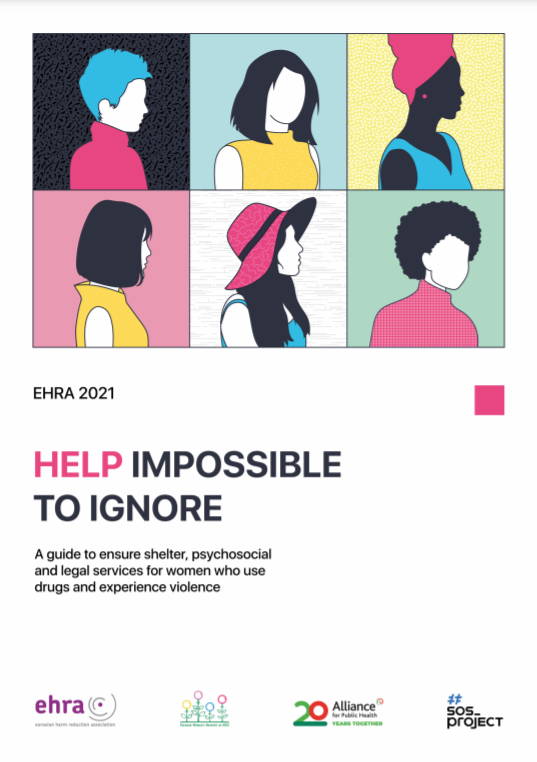
Guide Help Impossible to Ignore

Responding to the urgent need for change in 2021 EHRA has focused on increasing access to comprehensive care for women who use drugs and experience violence and together with partners developed The Guide “Help Impossible to Ignore”.

According to the World Health Organization (WHO), one-in-three women experiences intimate partner violence. Now an alarming situation with the increased rates of domestic/ intimate partner violence have been observed in relation to COVID-19 epidemic.

Women who use drugs are three-to five times more likely to experience gender-based violence than women in general. They are often caught up in a vicious cycle of gender-based violence and drug use where the stress and trauma of violence perpetuate the women’s drug use, and the actions and behaviors associated with drug use expose them to heightened risk of violence.

Women who use drugs and/or are involved in drug trafficking face multiple, mainly gender-based, stigmas and discrimination in society. They tend to have lower social and economic status within the community of people who use drugs which means that they face multiple health risks and barriers when trying to access services intended for survivors of gender-based violence. Quarantine measures worsen this situation even more with disrupted service provision, loss of income, restrictions on public transport, etc.

The Guide was developed by EHRA in partnership with Eurasian Women’s Network on AIDS (EWNA), which has a mission of protecting the rights of women living with, and vulnerable to, HIV, empowering them, making their stories and voices heard and enabling them to play a meaningful part in decision-making processes at different levels.

The author of the Guide is Halyna Korniienko from Ukraine with a vast experience in advocating for the rights of women who use drugs, working with paralegals, advocates and organizations providing services for women who use drugs and experience violence.

EHRA prepared this document as part of the project, “Access to comprehensive care for women using drugs in case of violence”, which is, in turn, part of a wider regional project entitled, “Sustainability of Services for Key Populations in Eastern Europe and Central Asia”. The latter is implemented by a consortium of EECA-based organisations led by the Ukraine-based Alliance for Public Health in partnership with 100% Life (formerly known as the All-Ukrainian Network of PLHIV), the Central Asian Association of People Living with HIV and the Eurasian Key Populations Health Network, with financial support from the Global Fund to Fight AIDS, Tuberculosis and Malaria.

The views expressed in this publication are solely those of the authors and do not necessarily reflect the views of the organisations that comprise the consortium and/or the Global Fund to Fight AIDS, Tuberculosis and Malaria.

The Global Fund to Fight AIDS, Tuberculosis and Malaria was neither involved in the preparation and approval of this document, nor in the conclusions arising from it.

On June 15, 2021 EHRA held an event to present the Guide and opportunities for its use in organizing services for women who use drugs and experience violence and also to highlight the problems of women who use drugs and experience violence when searching for help, challenges and possibilities in addressing their needs.

EHRA announces the General Meeting and Regional Meetings in Russia and South-Eastern Europe regions

On May 24 – June 6, 2021 Eurasian Harm Reduction Association (EHRA) conducts the General Meeting of its members. During the fortnight, members of EHRA will have online-voting on one question:

  1. Approval of EHRA financial report for 2020 year;

All members approved by EHRA Steering Committee may participate in the General Meeting. At the moment, there are 322 members. The full list of members is available on the EHRA website – https://old.harmreductioneurasia.org/ehra-members/

Members from the regions of Russia and South-Eastern Europe will also vote for the Steering Committee members to represent their region. Please, find information about the candidates to the Steering Committee to represent Russia and South-Eastern Europe here

Details on the voting procedure and participation can be clarified by contacting Eliza Kurcevic via e-mail: members@harmreductioneurasia.org

Letter of support for the decriminalization of the possession of small amounts of psychoactive substances in Lithuania

Eurasian Harm Reduction Association was asking international, regional and national partners to help urge the Members of the Parliament – the Seimas of Lithuania – to support the drug policy changes (decriminalization project) in Lithuania and sign the letter.

Until January 2017, possession of psychoactive substances in small amounts in Lithuania was considered an administrative offence, regulated by the Code of Administrative Offences and as a criminal offence, regulated by the Criminal Code. There were so-called legal collisions (conflict of laws).

In January 2017, procurement and possession of a small amount of an illicit drug with no intent to distribute became an offence punishable by community service, restraint of liberty, a fine or arrest. The same offence involving more than a defined small amount became a criminal offence punishable by up to two years in prison.

Over the past 3 years, alarming indicators have shown that drug policy in Lithuania is focused only on criminalization of people who use drugs and possess small amounts of drugs without the intent to distribute them. For example, possession of an illicit substance in small quantities without intent to supply accounted for 77% of all drug-related offences committed in 2019. 63 % of the offenders were under the age of 29. Between 2014 and 2019 there was an increase by 53,9% of drug laws related offences without intent to distribute. Each year, about 750 people are serving a custodial sentence in prisons, which costs Lithuania around 10,5 million Euro per year. In 2019, 21,7% of all inmates were officially diagnosed with mental and behavioral disorders due to drug use. While in prisons there are no harm reduction services, and limited access to OST.

At the moment, the Seimas of Lithuania is considering decriminalization of small amounts of drugs without the intent to distribute them.

Eurasian Harm Reduction Association collected 106 signatories from the supporting organizations from all over the world and sent is to the Parliament members of Lithuania.


Letter of support in English

Letter of support in Lithuanian

Online course: “Sustainability and Survival: Resilience for civil society organisations working with key populations in Central and Eastern Europe and Central Asia”

EHRA invites you to apply for the online course: “Sustainability and Survival: Resilience for civil society organisations working with key populations in Central and Eastern Europe and Central Asia”.

This collaborative and interactive skills development course is specifically designed for non-profit, civil society and community-based organizations from countries of the CECCA region, that advocate and/or provide direct services for key populations.  The course will help you, as a CSO or CBO working with key populations, to acquire skills and confidence for organisational resilience and a more diversified and sustainable funding model. By the end of this course, we expect you to be better equipped the challenges of the current and future evolving funding environment.

Specifically we will be supporting you in:

  • Strengthening the effectiveness and resilience of your organisation;
  • Development of the strategy and plan for sustainability and piloting specific income generation approaches;
  • Ensureing that your income generation streams and targets are aligned with organisational strategy, and respond to the current funding environment that you are facing;
  • Compareing the characteristics of a range of new income sources and analysing their potential fit for your organisation (e.g. crowdfunding, social enterprise, membership models, social contracting);
  • Facilitation of creative approaches to income generation with your colleagues.

The course offers the chance to join three 3-hour live and interactive online training workshops which will take place on June 1, 4 and 9, to view a series of webinars in your own time, and to undertake exercises to embed the learning between events. You will also have a mentor, who will be able to support you to practice and implement the learning, through a project of your choosing. Certificates will be issued to those that complete the course.

The course will be delivered in English and Russian language.

Authors of the course:  Anya Sarang, Dermott McDonald, Rachel Haynes, and Victoria Ireland.

Trainers of the course: Masha Plotko (EHRA) and Rachel Haynes

Сourse materials could be found HERE.

Who can apply? The programme is open to officially registered civil society / community-based organizations working with or for key communities (people who use drugs, men who have sex with men, LGBTQI+, sex workers) or people living with HIV, operating in one of 29 CEECA countries.

Participants must be employees of these organisations, that have been involved in one or more income generation activities of the organization. You must be able to commit  to the course in June and must be able to speak and write in Russian or English.

If you would like to participate, please complete this online survey by May 28. We will be letting you know if you have a place by May 31, 2021.

PLEASE NOTE: Participation in the course is free. The number of seats is limited to 10 organizations, 2 people from each organization (program and financial). The selection of participants will be on competitive bases, based on the quality of completed applications. Filling out the online survey does not guarantee participation in the course. We will inform you about enrolment in the group by May 31, 2021.

The course is delivered in the framework of the Eurasian Regional Consortium project “Thinking outside the box: overcoming challenges in community advocacy for sustainable and high-quality HIV services”, funded by the Robert Carr Fund for civil society networks.

EXTENDED: Grants to support the meaningful involvement of the civil society and communities’ representatives from EECA countries into the country dialogue processes related to the development of the national C19RM Funding Requests

The Eurasian Harm Reduction Association (EHRA) invites initiative groups, organizations of communities of people living with or affected by HIV and TB, as well as non-governmental HIV and TB focused organizations being involved into the implementation of Global Fund grants at the national level in EECA countries, and also those being involved in the response to the COVID-19 pandemic, to apply for grants to support the meaningful involvement of the civil society and communities’ representatives from EECA countries into the country dialogue processes related to the development of the national C19RM Funding Requests.

LIST OF POSSIBLE ACTIVITIES FOR SUPPORT (These are just examples. You may suggest your own activities):

• Conducting a needs assessment among representatives of a particular community in the context of the impact of and response on COVID-19;

• Conducting face-to-face meetings in order to identify interventions of a most priority for the representatives of a particular community to be included in the national C19RM funding request;

• Moderation of the online discussions with representatives of various communities in order to develop proposals for submission to the CCM. Expert to protocol such discussions and develop a final document with proposals; etc.

IMPLEMENTATION TIME: May – July 2021

LANGUAGES: Russian and English

REQUIREMENTS FOR APPLICANTS:

  • be registered as a legal entity in one of the EECA countries which received allocation within the Global Fund’s COVID-19 Response Mechanism; in case of initiative group, it should have a financial agent registered in one of such EECA countries.
  • only NGOs, non-for-profit organizations can apply. Initiative groups also can apply, but their financial agent should be NGO or non-for-profit organization.
  • work with / represent / provide services / advocate for the needs of key populations affected by HIV and / or TB at the national level.
  • Ensure coordination and consolidation of the content of the grant proposal with key non-governmental sector partners in the country involved into the development of the national C19RM funding request.

No more than 6 grants will be awarded for the period up to three months of implementation. The indicative budget for each grant is US $ 5,000. The EHRA could consider more ambitious applications, if justified.

Application deadline: May 21, 2021, 23:59 CET.

Applications will be considered and a decision on applications will be made as soon as they are received, and therefore it is recommended to submit applications as soon as possible.

HOW TO APPLY

To apply, please send the following documents by 21st of May 2021 23:59 CET to ivan@harmreductioneurasia.org:

  1. Filled application form, signed with the organization director or responsible representative.
  2. Filled work plan and budget in Excel format.
  3. Annex 1 – Registration document of the organization.

Applicants who have submitted an incomplete package of documents will not be considered as tender participants!

Invitation to participate in the additional selection of consultants for editing and proofreading of various types of documents: in English language, in Russian language.

Eurasian Harm Reduction Association (EHRA) invites you to submit a price offer (in EUR) for the following services:

а.  editing and proofreading in Russian (RE);

b. editing and proofreading in English (EE).

We invite you to submit your proposals to viktorija@harmreductioneurasia.org by May 12, 2021.

More information and application form is in the Request for quotes.

Invitation to participate in the tender for the selection of translators

Eurasian Harm Reduction Association (EHRA) invites you to submit a price offer (in EUR) for the following services:

  • translation from Russian into English,
  • translation from English into Russian,
  • translation from Lithuanian into English,
  • translation from English into Lithuanian,
  • translation from Russian into Lithuanian,
  • translation from Lithuanian into Russian;

We invite you to submit your proposals to viktorija@harmreductioneurasia.org by May 12, 2021.

More information and application form is in the Request for quotes.

Request for Proposals. Grants to support the meaningful involvement of the civil society and communities’ representatives from EECA countries into the country dialogue processes related to the development of the national C19RM Funding Requests

The Eurasian Harm Reduction Association (EHRA) invites initiative groups, organizations of communities of people living with or affected by HIV and TB, as well as non-governmental HIV and TB focused organizations being involved into the implementation of Global Fund grants at the national level in EECA countries, and also those being involved in the response to the COVID-19 pandemic, to apply for grants to support the meaningful involvement of the civil society and communities’ representatives from EECA countries into the country dialogue processes related to the development of the national C19RM Funding Requests.

LIST OF POSSIBLE ACTIVITIES FOR SUPPORT (These are just examples. You may suggest your own activities):

• Conducting a needs assessment among representatives of a particular community in the context of the impact of and response on COVID-19;

• Conducting face-to-face meetings in order to identify interventions of a most priority for the representatives of a particular community to be included in the national C19RM funding request;

• Moderation of the online discussions with representatives of various communities in order to develop proposals for submission to the CCM. Expert to protocol such discussions and develop a final document with proposals; etc.

IMPLEMENTATION TIME: May – July 2021

LANGUAGES: Russian and English

REQUIREMENTS FOR APPLICANTS:

  • be registered as a legal entity in one of the EECA countries which received allocation within the Global Fund’s COVID-19 Response Mechanism; in case of initiative group, it should have a financial agent registered in one of such EECA countries.
  • only NGOs, non-for-profit organizations can apply. Initiative groups also can apply, but their financial agent should be NGO or non-for-profit organization.
  • work with / represent / provide services / advocate for the needs of key populations affected by HIV and / or TB at the national level.
  • Ensure coordination and consolidation of the content of the grant proposal with key non-governmental sector partners in the country involved into the development of the national C19RM funding request.

No more than 6 grants will be awarded for the period up to three months of implementation. The indicative budget for each grant is US $ 5,000. The EHRA could consider more ambitious applications, if justified.

Application deadline: May 10, 2021, 23:59 CET.

Applications will be considered and a decision on applications will be made as soon as they are received, and therefore it is recommended to submit applications as soon as possible.

HOW TO APPLY

To apply, please send the following documents by 10th of May 2021 23:59 CET to ivan@harmreductioneurasia.org:

  1. Filled application form, signed with the organization director or responsible representative.
  2. Filled work plan and budget in Excel format.
  3. Annex 1 – Registration document of the organization.

Applicants who have submitted an incomplete package of documents will not be considered as tender participants!

Statement of Eastern Europe and Central Asia regional community networks to the United National General Assembly High Level Meeting on HIV and AIDS on key priorities in HIV and AIDS response

Prior to High Level Meeting on HIV and AIDS, EHRA together with other regional networks representing the communities of key populations and people living with HIV in Eastern Europe and Central Asia publishing joint statement to ensure that the new Political Declaration on HIV and AIDS:

  • The Declaration should not only describe the vision, priorities, policies, and plans of governments, but above all be a reflection of the needs of people and communities most affected by the HIV epidemic;
  • The Declaration should not only declare a general goal of ending the HIV epidemic but set up specific and measurable targets and results in protecting the health and social well-being of people and communities most affected by HIV;
  • The Declaration should include commitments and mechanisms of political and financial support for its implementation;
  • The Declaration should ensure the learning and dissemination of the best experiences and lessons learned by countries and communities over the four decades of working to protect human health and well-being from the HIV epidemic.

Taking into account the needs of communities and countries of Eastern Europe and Central Asia, we call upon inclusion in the new Political Declaration of particular positions as stated below:

  1. Look at us, see us. We are gravely concerned that Eastern Europe and Central Asia (EECA) is one of the only two regions in the world where the annual rate of HIV infections continues to rise at a concerning rate among key populations.
  2. No one should be left behind. Nothing for us without us. List all the key populations by name to stop the existing disregard, ignorance and discrimination of key populations, ensure meaningful involvemen and improve the space for advocacy and other cooperation between governments and key populations, and for community-led monitoring.
  3. Chase the virus, not people! Call for decriminalization of HIV exposure and transmission, same sex behavior, drug use and possession of drugs for personal use, sex work, in EECA countries and around the world.
  4. Let us work. Ensure favorable legal environment, including freedom of association so that communities can freely create and register non-profit organizations, receive public and donors’ funds, and provide services aligned with the needs of our communities. Ensure fair allocation of resources for the community-led response, including community-led monitoring and peer-led evidence-based services for key populations.
  5. Evidence is here. Ensure implementation. Focus on implementation of evidence-based, people-centered, human rights- and community-based integrated policies, practices and services on mental health and sexual and reproductive health and HIV for key populations.
  6. From words to actions. Ensure transformation of commitments into fully funded actions implemented at international and national level with transparency, inclusiveness, and effectiveness.

Please see full statement in English and Russian.