Terms of Reference for the EECA Regional Platform National Focal Points to help generating requests for the Global Fund’s CRG Technical Assistance in Armenia, Azerbaijan, Georgia

EHRA is looking for the experts to serve as the EECA Regional Platform National Focal Points in the following 3 countries: Armenia, Azerbaijan, Georgia.

Key tasks to be conducted by the experts.

Each expert selected to become the EECA Platform CRG TA National Focal Point is expected to assist the civil society and communities’ representatives in relevant country in development and submission of at least 1 successful request for the CRG TA per country in 2021.

The CRG TA Request to be considered as successful if it is approved by the Global Fund’s CRG Department for TA provision.

In particular, the EECA Platform CRG TA National Focal Points are expected to:

  • Initiate a dialogue with the civil society and communities’ representatives involved into the Global Fund related processes in each selected county about the opportunities available within the CRG TA Program.
  • Provide the civil society and communities’ representatives with all relevant information about the Global Fund CRG TA Program if needed.
  • Help the civil society and communities’ representatives to identify their needs for such TA, including identification of the potential problems which may need to be addressed, formulation of the objectives of such CRG TA in the context of the identified problems, as well as identification of the activities needed to be implemented as a part of the TA to address the identified problems and reach the set objectives.
  • Help to ensure the coordination of the content of the TA Requests among the key national civil society stakeholders, CCM and Fund Portfolio Manager before its submission.
  • Review the content of the draft TA Requests before the submission, help with its finalization if needed.
  • Help to follow up with the GF Secretariat CRG Department on the results of the TA Request consideration (if needed).

Online training on the key aspects of the CRG TA Program will be provided for the selected consultants by EHRA.

Cost of services and payment order

Payments will be done for each successful CRG TA request being generated with support of the EECA Platform CRG TA National Focal Point – 700 USD per TA request (not more than 1 request per country in 2021). Of this amount 350 USD will be paid after the fact of the submission of the TA request is confirmed, and other 350 USD will be paid after the request is accepted and approved for TA provision by Global Fund CRG Department. In case the TA request is rejected by Global Fund CRG Department – the second half of the 700 USD will not be paid to the Focal Point.

Also, 300 USD to be paid after the submission of the result of mapping of CSOs and CBOs – PRs, SRs and SSRs of the Global Fund grants in each of 3 countries.

Payment should be executed for the completed services after receiving invoice and act of service rendered.

The total contract cost for the work of one consultant under this ToR in 2021 should not exceed 1 000 USD (including all taxes).

How to apply

The individual consultants are invited to submit their CV and the Letter of Interest (LoI) by e-mail referenced under title “EECA Platform CRG TA Focal Point for [name of the country you are interested to work with]” to ivan@harmreductioneurasia.org by COB 19 July 2021 24:00 EET.

For more information please refer to the attached document.
Terms of Reference for the consultants to conduct the assessment of the fulfillment of HIV related sustainability commitments given by the national governments in the context of country transition from the Global Fund’s support to national funding in Bosnia and Herzegovina

Background

Being a partner of the Alliance for Public Health, the All-Ukrainian Network of PLWH 100% Life and other regional and national partners in the implementation of the Global Fund funded regional HIV project “Sustainability of services for key populations in Eastern Europe and Central Asia”, the Eurasian Harm Reduction Association (EHRA) is aimed at the improving the financial sustainability and allocative efficiency of HIV programs in EECA countries.

To contribute to this objective, EHRA is planning to conduct the assessment of the fulfillment of HIV related sustainability commitments given by the governments of 10 EECA countries in the context of their transition from the Global Fund‘s support to national funding, including Bosnia and Herzegovina. It is expected that based on the results of such assessment the key civil society regional and national partners working in those selected countries, will be able to adjust their advocacy efforts and actions to improve the financial sustainability and allocative efficiency of HIV national programs.

For that purposes in 2020 EHRA has developed a methodology and tools to conduct such assessment on a periodic basis.

EHRA is looking for a national consultant to help with conducting such assessment in Bosnia and Herzegovina. The assessment will be conducted retrospectively, taking into account that the implementation of the last Global Fund HIV grant ended in this country few years ago.

 Key tasks to be conducted by the consultant.

 The consultant is expected to organize the national assessment process in accordance with the Assessment Guide “Benchmarking Sustainability of the HIV Response in the Context of Transition from Donor Funding” to be provided by EHRA. The assessment process should include the next stages:

  1. Scoping: Identify and collect a set of strategic and programmatic documents, including national laws and regulations relevant to the transition process through desk review and interviews with key stakeholders.
  2. Conduct a review of those documents with the purpose to identify the government’s commitments with regards to transition; formulate and group commitments per the guidance provided by EHRA. Consultant should also identify where public/government’s commitments are deficient to properly address transition challenges or to be monitored.
  3. Coordinate and work with the national reference group to be composed of community representatives and national experts and engage them in (i) selecting priority commitments for the monitoring; (ii) define formulation of commitments if those are not sufficiently elaborated in public documents; and (iii) elaborate additional commitments if considered absolutely nessesary for transition process monitoring.
  4. Collect data through desk research and/or key informant interviews aimed to measure progress for the selected set of commitments.
  5. Input selected indicators into the Transition Monitoring Tool to calculate the score; and,
  6. Write an analytical report to summarize the findings.

A Sample Outline of the National Report is provided in Annex 5 to the Assessment Guide. The report should include contextual sections, findings and conclusions for each of the assessed commitment as well as general conclusions and recommendations for key national stakeholders.

Deliverables:

1.A. Repository and mapping of documents relevant to transition process (placeholders) and containing the government’s obligations with regards to transition (intentional or officially approved).

1.B. Repository of commitments, which the country (relevant public/governmental agencies) has committed to implement in support of transition of HIV response.

2. Filled in Transition Monitoring Tool.

3. Analytical Report on the results of the assessment of the fulfillment of HIV related sustainability commitments given by the national government in the context of country transition from the Global Fund’s support to national funding.

The language of the resulted documents should be English.

Also, the consultant is expected to take part in the national webinar to be organizer by EHRA to present on the results of the assessment.

Methodology, Instruments, Training and Technical Support

An Assessment Guide “Benchmarking Sustainability of the HIV Response in the Context of Transition from Donor Funding” together with the Transition Monitoring Tool in Excel format will be provided to the consultant by EHRA in English.

An online training on the assessment framework, methodology and tools will be organized by EHRA for the selected consultant to help better understand the methodology requirements and approach, assessment process and the expected results.

EHRA will also provide online mentorship and support to the national expert during the process of the assessment through the regular conference calls and by periodic review of the assessment outputs.

Consultant is expected to be available for a by-weekly calls with EHRA assigned staff/experts to discuss the progress/challenges with the completion of the assessment.

Timeframe

  • The online training on the methodology and instruments will be organized by EHRA for the selected consultant by end of July.
  • The first 3 of the above-mentioned stages of the assessment process should be completed by 31.08.2021. The report outline, instruments for structuring information and interview guide should be agreed with EHRA in case they are changed\adjusted. List of the National Reference Group members should be agreed with EHRA as well by that date.
  • Stages 4 and 5 should be completed by 23.09.2021.
  • The draft report should be provided to the EHRA colleagues for the review and feedback by 10.10.2021.
  • The final report and all other deliverables should be submitted by 30.10.2021.

Cost of services

The total contract cost for the work of one consultant under this ToR should not exceed 3,000 USD (including all taxes).

Evaluation Criteria

An evaluation panel will assess the extent to which proposals submitted in response to this announcement meet the evaluation criteria below.

The minimum technical score is 90. Only candidates with a minimum score of 90 points out of a maximum of 100 are considered eligible for the assignment. Consultants with proven work experience in the community organization would be given a priority.

The candidates with the highest technical score that meets the requirement will be invited for negotiation of the agreement.

A consultant under this assignment is a person who carries overall responsibility for planning and conducting the study and in drafting the report. Given the essential role of this individual, she/he should possess the following knowledge and experience:

Criteria Weighting
Excellent understanding of the national HIV service delivery and funding systems as well as of the Global Fund related processes at the national level 20 points
Access to the documents containing HIV related sustainability commitments given by the national government in the context of country’s transition from the Global Fund’s support to national funding in Bosnia and Herzegovina 20 points
Knowledge of, and access to, relevant stakeholders to be interviewed, including government officials, community members, and other experts 20 points
Experience of undertaking similar assessments and a strong record of adherence to evidenced-based approaches 20 points
Good understanding and access to the most recent national HIV epidemiological data 10 points
Proven set of skills for interviewing, conducting a literature review, and writing (including in English) 10 points
Total 100 points
Additionally, the consultants should have:

  • No conflict of interest (should be declared in the Letter of Interest);
  • Fluent English and national language.

How to apply

The individual consultants are invited to submit their CV and the Letter of Interest by e-mail referenced under title “Consultant to conduct the assessment of transition related commitments in B&H” to ivan@harmreductioneurasia.org by COB 19 of July 2021 24:00 EET.


Support Don’t Punish

SDP1
SDP2
Support Don't Punish

For more please read here

OST assessment methodologies

Support Don't Punish

For more please read here

Drug Education Assessment Report

SDP8
Support Don't Punish

For more please read here

Human Rights Protection

Results of the EHRA General and Regional meetings to elect new Steering Committee members

During May 24 – June 6, 2021 Eurasian Harm Reduction Association (EHRA) conducted online General and Regional members’ meetings in Russia and South-Eastern Europe. Quorum for the General and Regional meetings to elect new Steering Committee members needed no less than one third of the members for General meeting and no less than one third of the members from the particular region.

GENERAL MEETING. EHRA has 316 organizational and individual members, who were eligible to vote. From 316 members – 132 participated in the General meeting. It means, that quorum was met, because 41,77% of members participated in it.

The results of approval of EHRA financial report for 2020 year:

  • 123 members confirmed EHRA financial report for 2020;
  • 9 members abstained;
  • 0 members did not confirm.

EHRA financial report for 2020 year is approved.

REGIONAL MEETINGS

RUSSIA. In total the region has 46 official EHRA members, who were eligible to vote. From those 46 members – 26 participated in the meeting and cast the vote for their candidate, which means, that quorum was met, because 56,52% of members from the region participated in the elections of the SC member.

The results of voting:

  • Aleksey Lakhov – 8 votes (30,8% of all valid votes)
  • Aydana Fedosik – 7 votes (26,9% of all valid votes)
  • Natalya Sidorenko – 7 votes (26,9% of all valid votes)
  • Aleksey Korolkov – 4 votes (15,4% of all valid votes)

Aleksey Lakhov is elected for 3 years term as EHRA Steering Committee member to represent Russia region.
SOUTH-EASTERN EUROPE. In total the region has 26 official EHRA members, who were eligible to vote. From those 26 members – 10 participated in the meeting and cast the vote for their candidate, which means, that quorum was met, because 38,46% of members from the region participated in the elections of the SC member.

The results of voting:

  • 10 participants voted for candidate Denis Dedajic (100% of all valid votes)

Denis Dedajic is elected for 3 years term as EHRA Steering Committee member to represent South-Eastern Europe region.

Contest of mass media materials on life and problems of people who use psychoactive substances

TO THE ATTENTION OF MASS MEDIA IN THE REGION OF CENTRAL AND EASTERN EUROPE AND CENTRAL ASIA (CEECA) 

in the framework of “Chase the virus, not people!” campaign** 

Background 

More than 3 million people who use psychoactive substances live in the countries of Central and Eastern Europe and Central Asia (CEECA). The CEECA region has the fastest-growing HIV epidemic in the world and high rates of hepatitis C and overdose mortality. Although harm reduction programs to some extent are available in 28 out of 29 countries in the CEECA region, the scope, quality, accessibility, and sustainable financing of these programs are so low in many CEECA countries that their impacts on the public have been insignificant.  

Many countries within CEECA have a political environment that maintains repressive drug policies, leading to stigma, discrimination, criminalization and imprisonment of people who use psychoactive substances, which are the major causes of hatred and inhumanity rooted in the society in relation to people who use drugs. Drug use or drug addiction diagnosis should not be the grounds for deprivation or restriction of political, economic, social and cultural rights. Years of anti-drug policies implementation and criminalization have led to systematic violations of the rights of millions of people who use drugs, including their right to life.  

In anticipation of the World Drug Day, June 26, and the International Overdose Awareness Day, August 31, Eurasian Harm Reduction Association (EHRA) encourages all responsible mass media representatives, bloggers, social media activists to take part in the Contest of media materials dedicated to the life and problems of people who use psychoactive substances.  

The aim of the contest:  

to encourage materials in traditional media channels (printing, radio, TV) as well as in social media (Facebook, Instagram, Twitter, YouTube etc.) on influence of stigma, discrimination and criminalization on the lives of people who use psychoactive substances in CEECA countries to increase public awareness and stimulate actions to overcome those challenges.  

Assignment for mass media: 

to create an article / post / video / programme / podcast / investigation / interview, etc. to address stigma, discrimination or criminalization of people who use psychoactive substances in your city or country.  

Contest timeline:  

  • Materials developed for the contest should be posted/published/aired in the period of June 20 – September 30, 2021.
  • Materials (relevant links and audience coverage) should be sent to jurgita@harmreductioneurasia.org no later than October 15, 2021.
  • Contest results announcement – December 1, 2021.

Contest is conducted in 4 media categories:  

  1. Printed media (newspapers/magazines/websites)
  2. TV (including online TV and vlogs)
  3. Radio 
  4. Social Media

The materials may be dated (but not necessarily) to June 26 (World Drug Day) and August 31 (International Overdose Awareness Day).   

Contest awards*:  

3 winners in each media category will be awarded the prize:  

1st place – 1000USD  

2nd place – 750 USD 

3rd place – 500 USD  

The contest committee will evaluate the contestants’ materials considering the following criteria:  

  • creativity(the author’s creative work) (25 points) 
  • originality(uniqueness of the topic, story or the way the topic is presented) (25 points) 
  • the language of the text or the visual expression (clarity, tolerance, expressive features) (10 points) 
  • the relevance of the material (15 points) 
  • the reach of the material (unique readers, watchers, listeners, likes, shares, achieved audience overall) (25 points) 

Language: all materials are welcome in a national language.  

Only materials expressing neutral and tolerant attitude and using appropriate not stigmatizing language will be allowed to participate in the contest. Please review the glossary of recommended language use in English and Russian and EHRA Drug Policy Position for reference.  

For all interested in the Contest and wishing to learn more or to ask questions, 2 online Q&A sessions (dates and links updated on June 8, 2021) will be organized (one in English and one in Russian): 

  • 16thof June at 16:00 GMT+3 (for English speaking participants)  

https://clck.ru/VLWty 

  • 17thof June at 14:00 GMT+3 (for Russian speaking participants) 

https://clck.ru/VLX3j

Jury: led by Eurasian Harm Reduction Association the jury will include national partners from countries, participating in the contest.  

Prizes to be awarded in each media category*: 

4 First places – 4000 USD (1000 USD per material) 

4 Second places – 3000 USD (750 USD per material) 

4 Third places – 2000 USD (500 USD per material) 

 * The amount includes all taxes. The winner is solely responsible for the calculation and payment of all taxes and fees which he / she / they is required to pay according to the state law of which he / she / they is a citizen or resident.

**About the campaign “Chase the virus, not people!” 

Eastern Europe and Central Asia (EECA) remains the only region in the world where new HIV cases continue to rise, and AIDS-related deaths are still high. To attract worldwide attention to the barriers that key communities and people living with HIV in the region face to access HIV prevention, treatment and care, the regional communities’ networks have joined forces in the campaign “Chase the virus, not people!” to represent interests of key populations affected by HIV: people living with HIV, women living with HIV, youth and teenagers, affected by HIV, people who use drugs, sex workers, men who have sex with men, trans* people.  

Launched at the International AIDS 2018 Conference in Amsterdam in 2018 the campaign continues through national initiatives, bringing together new partners and supporters to raise awareness of key populations’ problems and reduce stigma and discrimination in society.

Campaign coordinator – Eurasian Harm Reduction Association (EHRA) 


Contest for the best blog A Day in the Life of a Substitution Treatment Client

The Eurasian Harm Reduction Association invites clients of the opioid substitution therapy program to share their stories in personal blogs “A Day in the Life of a Substitution Treatment Client”. Clients of the program are the best experts in assessing the quality of the provided services. The selected stories will be published on the EHRA website and, with the author’s consent, will be used to promote questions regarding the quality of substitution therapy programs in the region.

We expect you to:

  • Describe in lively simple language how the client’s day is arranged (what time it is necessary to get up, how long it takes to get to the clinic, what the building looks like, the surrounding space and the office itself. How the program is integrated into your life (work, children, other responsibilities))
  • Share your feelings, emotions (How do you feel, what you think about when you go/drive for the medicine, stand in line, talk to a doctor, leave the office)
  • Tell us how participation in the program affects your social life (Do your family members know? Colleagues at work? How do they feel?)

Stories must be written in Russian or English. Don’t worry about the literacy of the text, we will help you edit it.

Attach photographs to the story (for example, a bus stop, a road, a building, posters at the clinic/site, whatever you see fit or what matters to you and complements the story). You can insert quotes from doctors, relatives, colleagues, friends.

When selecting the winners, we will pay attention to:

  • Completeness, richness of the text (20 points)
  • Author’s style, eloquent and interesting presentation of the material (15 points)
  • Reflection of problem areas/bottlenecks of the program (inconvenient location of the site, lack of take-home OST, inaccessibility of OST treatment in hospitals or prisons, staff rudeness, insufficiency of provided services, etc.) (35 points)
  • Consistent, captivating story (30 points)

A total of 6 winners will be selected.

Winners of the contest will receive the monetary reward:

  • 1 place – 500 USD
  • 2 place (2 pc) – 400 USD
  • 3 place (3 pc) – 250 USD

Looking forward to receiving your stories until August 1, 2021 at maria@harmreductioneurasia.org.

EXTENDED: EHRA is looking for consultants to develop an interactive online training course on digital services

EHRA is looking for the consultants to develop an interactive online training course on digital services for key population groups that are vulnerable to HIV, including people who use drugs, men who have sex with men, trans* people and women living with HIV.

The new deadline for submission is before 24:00 EET on May 31, 2021.

Eurasian Harm Reduction Association  (EHRA) as part of the Eurasian Regional Consortium’s project “Thinking outside the box: overcoming challenges in community advocacy for sustainable and high-quality HIV services” supported by the Robert Carr Fund for civil society networks (RCF) is looking for qualified providers to develop and conduct an interactive online training course on digital services for key populations (people who use drugs, men who have sex with men, trans people and women living with HIV).

Tasks under this tender

The purpose of the course is to build capacities of peer workers, social workers, psychologists and other specialists who are involved in provision of online/remote services and managers of those programs for a better quality of those services. The course should take into account the information, conclusions, and recommendations provided in THIS technical draft[1] of the executive summary of the Report on Mapping Digital and Remote Healthcare-Social HIV Services for Key Populations in countries of Central, Eastern Europe and Central Asia.

  1. Develop and produce interactive online training course allowing potential users to progress in an engaging virtual learning environment. Course content and delivery should be designed in a way that participants can complete the course 90% independently. 10% of the course should include mentoring, supervision or coaching support.

The course should contain the following thematic blocks:

  • role and specifics of digital services in package of services for key populations;
  • planning and management of digital services;
  • practical skills building to improve provision of quality services;
  • safety and confidentiality (for both client and consultant);
  • ethics of consultant-client relationship in an online environment.
  1. Place the content of the course to existing online course platform: https://ehra.learnworlds.com/home.
  2. Pilot the course and, based on the results of the pilot (feedback from the participants and EHRA), make necessary changes in course design and content.
  3. Produce scripts/guidelines for mentors and trainers of the course.

All course materials should be available in Russian and English.

[1] https://harmreductioneurasia-my.sharepoint.com/:w:/g/personal/igor_harmreductioneurasia_org/ERGwxX-JzBdGnQxwWBtztsQBa2d1xtyNM8vmJ7TbkPVS1g?e=tGKNBW

How to apply

Applicants must submit:

  • Technical proposal;
  • Cost proposal;
  • CVs of individual consultants or teams proposed for this assignment with references to their previous experience in similar tasks;

The subject of the letter is “Digital services course” and subject line of your attachment must

be labeled as follows:

  • Your name_technical proposal
  • Your name_cost proposal

The proposal should be submitted to igor@harmreductioneurasia.org,

The deadline for submission is before 24:00 EET on May 31, 2021.

Please see full ToR

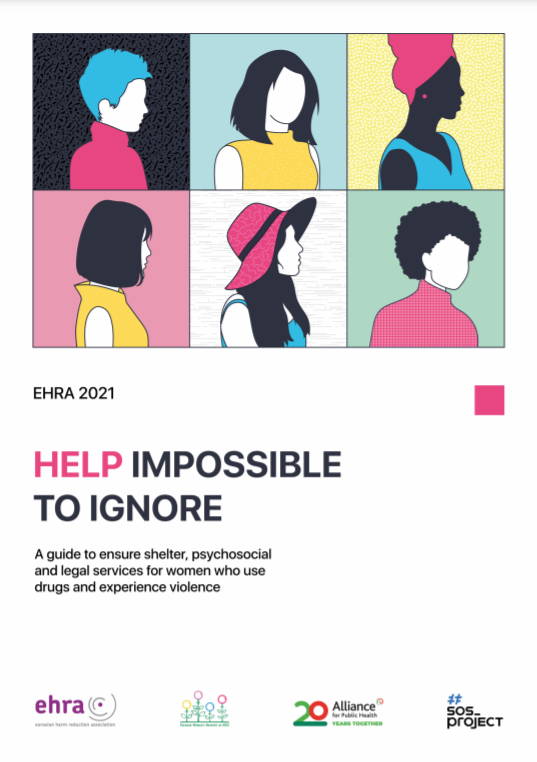
Guide Help Impossible to Ignore

Responding to the urgent need for change in 2021 EHRA has focused on increasing access to comprehensive care for women who use drugs and experience violence and together with partners developed The Guide “Help Impossible to Ignore”.

According to the World Health Organization (WHO), one-in-three women experiences intimate partner violence. Now an alarming situation with the increased rates of domestic/ intimate partner violence have been observed in relation to COVID-19 epidemic.

Women who use drugs are three-to five times more likely to experience gender-based violence than women in general. They are often caught up in a vicious cycle of gender-based violence and drug use where the stress and trauma of violence perpetuate the women’s drug use, and the actions and behaviors associated with drug use expose them to heightened risk of violence.

Women who use drugs and/or are involved in drug trafficking face multiple, mainly gender-based, stigmas and discrimination in society. They tend to have lower social and economic status within the community of people who use drugs which means that they face multiple health risks and barriers when trying to access services intended for survivors of gender-based violence. Quarantine measures worsen this situation even more with disrupted service provision, loss of income, restrictions on public transport, etc.

The Guide was developed by EHRA in partnership with Eurasian Women’s Network on AIDS (EWNA), which has a mission of protecting the rights of women living with, and vulnerable to, HIV, empowering them, making their stories and voices heard and enabling them to play a meaningful part in decision-making processes at different levels.

The author of the Guide is Halyna Korniienko from Ukraine with a vast experience in advocating for the rights of women who use drugs, working with paralegals, advocates and organizations providing services for women who use drugs and experience violence.

EHRA prepared this document as part of the project, “Access to comprehensive care for women using drugs in case of violence”, which is, in turn, part of a wider regional project entitled, “Sustainability of Services for Key Populations in Eastern Europe and Central Asia”. The latter is implemented by a consortium of EECA-based organisations led by the Ukraine-based Alliance for Public Health in partnership with 100% Life (formerly known as the All-Ukrainian Network of PLHIV), the Central Asian Association of People Living with HIV and the Eurasian Key Populations Health Network, with financial support from the Global Fund to Fight AIDS, Tuberculosis and Malaria.

The views expressed in this publication are solely those of the authors and do not necessarily reflect the views of the organisations that comprise the consortium and/or the Global Fund to Fight AIDS, Tuberculosis and Malaria.

The Global Fund to Fight AIDS, Tuberculosis and Malaria was neither involved in the preparation and approval of this document, nor in the conclusions arising from it.

On June 15, 2021 EHRA held an event to present the Guide and opportunities for its use in organizing services for women who use drugs and experience violence and also to highlight the problems of women who use drugs and experience violence when searching for help, challenges and possibilities in addressing their needs.

EHRA announces the General Meeting and Regional Meetings in Russia and South-Eastern Europe regions

On May 24 – June 6, 2021 Eurasian Harm Reduction Association (EHRA) conducts the General Meeting of its members. During the fortnight, members of EHRA will have online-voting on one question:

  1. Approval of EHRA financial report for 2020 year;

All members approved by EHRA Steering Committee may participate in the General Meeting. At the moment, there are 322 members. The full list of members is available on the EHRA website – https://old.harmreductioneurasia.org/ehra-members/

Members from the regions of Russia and South-Eastern Europe will also vote for the Steering Committee members to represent their region. Please, find information about the candidates to the Steering Committee to represent Russia and South-Eastern Europe here

Details on the voting procedure and participation can be clarified by contacting Eliza Kurcevic via e-mail: members@harmreductioneurasia.org

Letter of support for the decriminalization of the possession of small amounts of psychoactive substances in Lithuania

Eurasian Harm Reduction Association was asking international, regional and national partners to help urge the Members of the Parliament – the Seimas of Lithuania – to support the drug policy changes (decriminalization project) in Lithuania and sign the letter.

Until January 2017, possession of psychoactive substances in small amounts in Lithuania was considered an administrative offence, regulated by the Code of Administrative Offences and as a criminal offence, regulated by the Criminal Code. There were so-called legal collisions (conflict of laws).

In January 2017, procurement and possession of a small amount of an illicit drug with no intent to distribute became an offence punishable by community service, restraint of liberty, a fine or arrest. The same offence involving more than a defined small amount became a criminal offence punishable by up to two years in prison.

Over the past 3 years, alarming indicators have shown that drug policy in Lithuania is focused only on criminalization of people who use drugs and possess small amounts of drugs without the intent to distribute them. For example, possession of an illicit substance in small quantities without intent to supply accounted for 77% of all drug-related offences committed in 2019. 63 % of the offenders were under the age of 29. Between 2014 and 2019 there was an increase by 53,9% of drug laws related offences without intent to distribute. Each year, about 750 people are serving a custodial sentence in prisons, which costs Lithuania around 10,5 million Euro per year. In 2019, 21,7% of all inmates were officially diagnosed with mental and behavioral disorders due to drug use. While in prisons there are no harm reduction services, and limited access to OST.

At the moment, the Seimas of Lithuania is considering decriminalization of small amounts of drugs without the intent to distribute them.

Eurasian Harm Reduction Association collected 106 signatories from the supporting organizations from all over the world and sent is to the Parliament members of Lithuania.


Letter of support in English

Letter of support in Lithuanian