How to write a successful small grant application?

Each year, EHRA and other partners in the region are announcing small grants programs. We are sure, you heard, or maybe even applied for it?

Most of the applications we receive consist of great and inspiring ideas. But at the same time, some of them lack consistency. So, if you ever asked yourself “Why was my project not selected?” or “Why was my project not selected the third time in a row?”, we are here to help and guide you on how to write a successful small grant application.


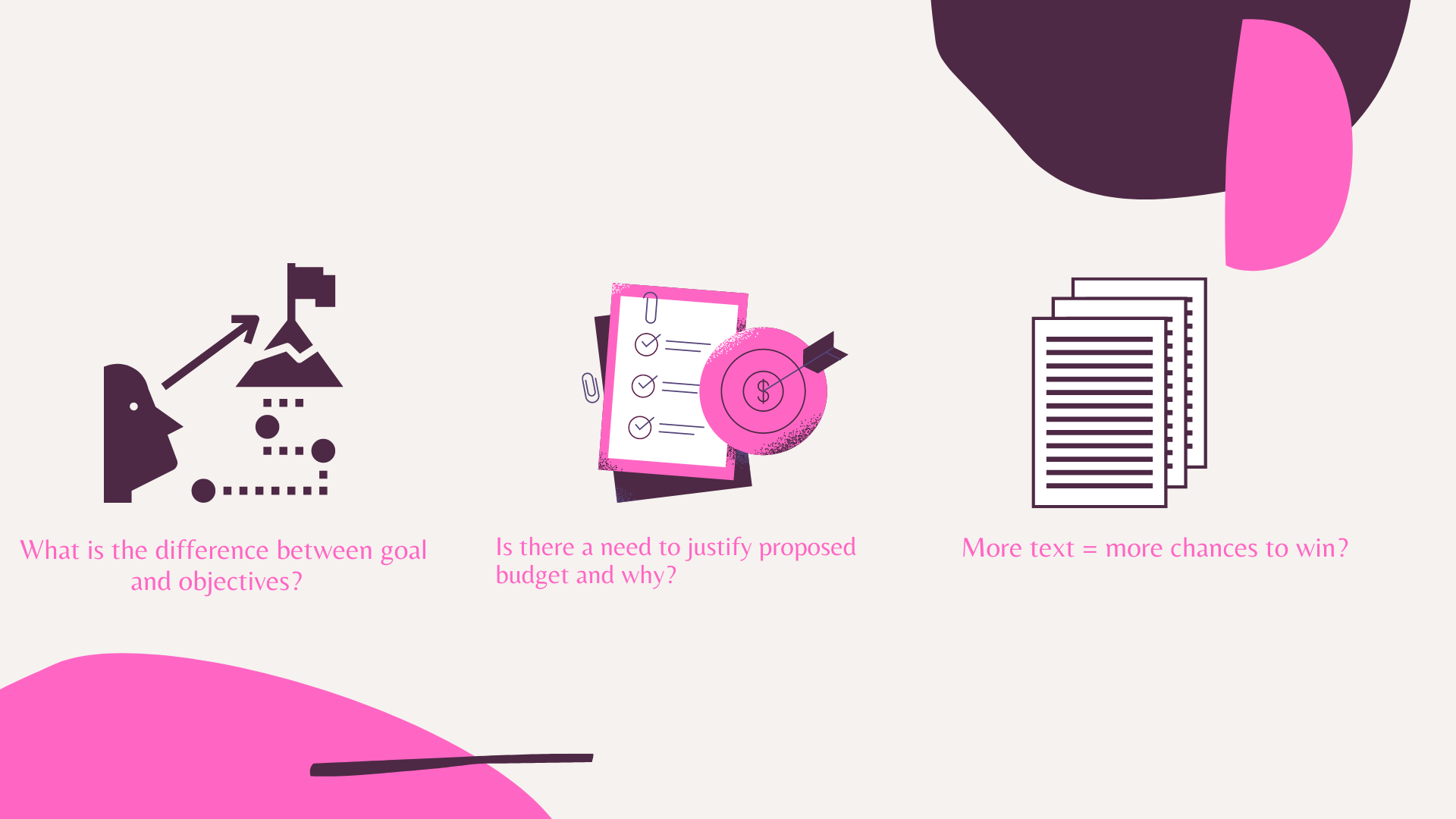
On March 23, 2021, EHRA held a practical webinar “How to write a successful small grant application?”. Participants of the webinar learned what algorithm to use working over the application, why the topic of the competition is important, and how to link it with the goal of the grant, whether a lot of text is good or bad, what the goal, objectives, and activities are, how to make a budget and check your application.

The presentation and recording of the webinar are available on the EHRA educational platform at https://ehra.learnworlds.com/course/how-to-write-small-grant-application. Registration is required to access the platform.
EHRA is looking for a consultant to develop regional report on new psychoactive substance use in CEECA region

The Eurasian Harm Reduction Association (EHRA) as a part of the three years project of the International Harm Reduction Consortium “We Will Not End AIDS Without Harm Reduction” is looking for a consultant to develop a regional report on new psychoactive substance (NPS) use in CEECA region.

Tasks of the consultant and expected results:

  • To read and analyse 8 country reports[1] on NPS use in Moldova, Belarus, Georgia, Serbia, Kazakhstan, Kyrgyzstan, Estonia and Lithuania.
  • To prepare outline for the report and agree it with EHRA.
  • To prepare regional report (in English or Russian), based on the above-mentioned reports, not exceeding 30 pages.

Proposed timeline:

All tasks should be completed in the period from 3rd May till 30th June, 2021.

Selection of the consultants will be done by the Commission in EHRA, based on the following Evaluation criteria:

  • Relevant experience in developing regional/ international reports (40 points)
  • Relevant experience in harm reduction/drug policy field and/or in new psychoactive substances (30 points)
  • Fluency in written Russian and/or English (30 points)

Condition

This announcement and its attachments shall not be construed as a contract or a commitment of any kind. This request for proposals in no way obligates EHRA to award a contract, nor does it commit EHRA to pay any cost incurred in the preparation and submission of the proposals.

Terms of payment and other conditions same as a final timeline will be indicated in the agreement which EHRA will sign with the winner.


HOW TO APPLY?

The candidates are invited to submit their:

  • CV
  • Letter of interest with the suggested consultancy fee (in EUR or USD) and
  • 1-2 examples of the regional/ international reports, developed by the candidate.

Please, send your documents by e-mail referenced under title “NPS report consultant” to Eliza Kurcevic at eliza@harmreductioneurasia.org by 23rd April 2021, 23:59 EET.

Results will be announced by 28th April 2021. Each candidate will be contacted individually.

Any questions regarding the participation should be sent to eliza@harmreductioneurasia.org

[1] Lithuania country report will be published on EHRA website in the end of April/ beginning of May

Extended: Terms of Reference for the EECA Regional Platform sub-regional Focal Points to help generating the CRG Technical Assistance Requests

Background

Since 2017 Eurasian Harm Reduction Association is being the host of the EECA regional Platform for Communication and Coordination. One of the EHRA responsibilities in its role as EECA Regional Platform is to promote the Global Fund’s Community, Rights and Gender (CRG) Technical Assistance Technical Assistance Program among civil society and communities’ representatives involved into the Global Fund related processes in EECA countries.

To better motivate and support CSOs and CBOs in the region to use the Technical Assistance (TA) available within this Program in 2021, EHRA is planning to sub-contract 4 experts to serve as the sub-regional EECA Regional Platform Focal Points aimed on generating the demand for the Global Fund’s CRG TA.

EHRA is looking for the experts to serve as the EECA Regional Platform Focal Points in the following 2 sub-regions: Caucasus (Armenia, Azerbaijan, Georgia), and second block – Belarus, Moldova, Russia, Ukraine.


Key tasks to be conducted by the consultants

 Each expert selected to become the EECA Platform CRG TA Focal Point is expected to assist the civil society and communities’ representatives in relevant sub-regions in development and submission of at least 3 successful requests for the CRG TA per sub-region in 2021 (1 per quarter on average).

The CRG TA Request to be considered as successful if it is approved by the Global Fund’s CRG Department for TA provision.

In particular, the EECA Platform CRG TA Focal Points are expected to:

  • Initiate a dialogue with the civil society and communities’ representatives involved into the Global Fund related processes in each county of the selected sub-region about the opportunities available within the CRG TA Program.
  • Provide the civil society and communities’ representatives with all relevant information about the Global Fund CRG TA Program if needed.
  • Help the civil society and communities’ representatives to identify their needs for such TA, including identification of the potential problems which may need to be addressed, formulation of the objectives of such CRG TA in the context of the identified problems, as well as identification of the activities needed to be implemented as a part of the TA to address the identified problems and reach the set objectives.
  • Help to ensure the coordination of the content of the TA Requests among the key national civil society stakeholders, CCM and Fund Portfolio Manager before its submission.
  • Review the content of the draft TA Requests before the submission, help with its finalization if needed.
  • Help to follow up with the GF CRG Department on the results of the TA Request consideration.

 Online training on the key aspects of the CRG TA Program will be provided for the selected consultants by EHRA at the beginning of March.

Also, the EECA Platform CRG TA Focal Points will be expected to do the mapping of the civil society and community-based organizations being the principal, sub and sub-sub-recipients of the Global Fund HIV and TB grants in all countries of the relevant sub-regions, where the Global Fund programs are implemented. The template Excel form for such mapping will be provided by EHRA.


Deliverables and Time frame

 3 CRG TA Requests per each sub-region being developed, submitted with the support of the EECA Platform CRG TA Focal Point and approved for the TA provision by the Global Fund CRG Department in 2021.

Mapping of principal, sub and sub-sub-recipients of the Global Fund HIV and TB grants in the countries of relevant sub-regions conducted.

Cost of services and payment order

 Payments will be done for each successful CRG TA request being generated with support of the EECA Platform CRG TA Focal Point – 700 USD per TA request (not more than 3 requests per sub-region altogether in 2021). Of this amount 350 USD will be paid after the fact of the submission of the TA request is confirmed, and other 350 USD will be paid after the request is accepted and approved for TA provision by Global Fund CRG Department. In case the TA request is rejected by Global Fund CRG Department – the second half of the 700 USD will not be paid to the Focal Point.

Also, 300 USD to be paid after the submission of the result of mapping of CSOs and CBOs – PRs, SRs and SSRs of the Global Fund grants in all countries of the relevant sub-region, where the Global Fund programs are implemented.

Payment should be executed for the completed services after receiving invoice and act of service rendered.

The total contract cost for the work of one consultant under this ToR in 2021 should not exceed 2 400 USD (including all taxes).


Evaluation Criteria

An evaluation panel will assess the extent to which proposals submitted in response to this announcement meet the evaluation criteria below.

The minimum technical score is 90. Only candidates with a minimum score of 90 points out of a maximum of 100 are considered eligible for the assignment. Consultants with proven work experience in the community organization would be given a priority.

The candidates with the highest technical score that meets the requirement will be invited for negotiation of the agreement.

Criteria Weighting
Good understanding of the Global Fund CRG TA Program (should be clear from LoI) 25 points
Knowledge of, and access to the relevant civil society stakeholders involved into the Global Fund related processes in the countries of the particular sub-region as well as established contacts with the GF Secretariat (regional team and CRG Department in particular) (should be clear from LoI) 25 points
Experience of undertaking similar TA related assessments or other relevant work experience (should be clear from CV and LoI) 25 points
Proven set of communication and writing skills (should be clear from LoI) 25 points
Total 100 points
Additionally, the consultants should have:

  • No conflict of interest (should be declared in the Letter of Interest);
  • Fluent English and a language most relevant for the sub-region the expert is interested to work with.

How to apply

 The individual consultants are invited to submit their CV and the Letter of Interest (LoI) by e-mail referenced under the title “EECA Platform CRG TA Focal Point for [name of the sub-region you are interested to work with]” to ivan@harmreductioneurasia.org by COB 21 April 2021 24:00 EET.

Terms of Reference for the EECA Regional Platform sub-regional Focal Points to help generating the CRG Technical Assistance Requests

Background

Since 2017 Eurasian Harm Reduction Association is being the host of the EECA regional Platform for Communication and Coordination. One of the EHRA responsibilities in its role as EECA Regional Platform is to promote the Global Fund’s Community, Rights and Gender (CRG) Technical Assistance Technical Assistance Program among civil society and communities’ representatives involved into the Global Fund related processes in EECA countries.

To better motivate and support CSOs and CBOs in the region to use the Technical Assistance (TA) available within this Program in 2021, EHRA is planning to sub-contract 4 experts to serve as the sub-regional EECA Regional Platform Focal Points aimed on generating the demand for the Global Fund’s CRG TA.

EHRA is looking for the experts to serve as the EECA Regional Platform Focal Points in the following 2 sub-regions: Caucasus (Armenia, Azerbaijan, Georgia), and second block – Belarus, Moldova, Russia, Ukraine.


Key tasks to be conducted by the consultants

 Each expert selected to become the EECA Platform CRG TA Focal Point is expected to assist the civil society and communities’ representatives in relevant sub-regions in development and submission of at least 3 successful requests for the CRG TA per sub-region in 2021 (1 per quarter on average).

The CRG TA Request to be considered as successful if it is approved by the Global Fund’s CRG Department for TA provision.

In particular, the EECA Platform CRG TA Focal Points are expected to:

  • Initiate a dialogue with the civil society and communities’ representatives involved into the Global Fund related processes in each county of the selected sub-region about the opportunities available within the CRG TA Program.
  • Provide the civil society and communities’ representatives with all relevant information about the Global Fund CRG TA Program if needed.
  • Help the civil society and communities’ representatives to identify their needs for such TA, including identification of the potential problems which may need to be addressed, formulation of the objectives of such CRG TA in the context of the identified problems, as well as identification of the activities needed to be implemented as a part of the TA to address the identified problems and reach the set objectives.
  • Help to ensure the coordination of the content of the TA Requests among the key national civil society stakeholders, CCM and Fund Portfolio Manager before its submission.
  • Review the content of the draft TA Requests before the submission, help with its finalization if needed.
  • Help to follow up with the GF CRG Department on the results of the TA Request consideration.

 Online training on the key aspects of the CRG TA Program will be provided for the selected consultants by EHRA at the beginning of March.

Also, the EECA Platform CRG TA Focal Points will be expected to do the mapping of the civil society and community-based organizations being the principal, sub and sub-sub-recipients of the Global Fund HIV and TB grants in all countries of the relevant sub-regions, where the Global Fund programs are implemented. The template Excel form for such mapping will be provided by EHRA.


Deliverables and Time frame

 3 CRG TA Requests per each sub-region being developed, submitted with the support of the EECA Platform CRG TA Focal Point and approved for the TA provision by the Global Fund CRG Department in 2021.

Mapping of principal, sub and sub-sub-recipients of the Global Fund HIV and TB grants in the countries of relevant sub-regions conducted.

Cost of services and payment order

 Payments will be done for each successful CRG TA request being generated with support of the EECA Platform CRG TA Focal Point – 700 USD per TA request (not more than 3 requests per sub-region altogether in 2021). Of this amount 350 USD will be paid after the fact of the submission of the TA request is confirmed, and other 350 USD will be paid after the request is accepted and approved for TA provision by Global Fund CRG Department. In case the TA request is rejected by Global Fund CRG Department – the second half of the 700 USD will not be paid to the Focal Point.

Also, 300 USD to be paid after the submission of the result of mapping of CSOs and CBOs – PRs, SRs and SSRs of the Global Fund grants in all countries of the relevant sub-region, where the Global Fund programs are implemented.

Payment should be executed for the completed services after receiving invoice and act of service rendered.

The total contract cost for the work of one consultant under this ToR in 2021 should not exceed 2 400 USD (including all taxes).


Evaluation Criteria

An evaluation panel will assess the extent to which proposals submitted in response to this announcement meet the evaluation criteria below.

The minimum technical score is 90. Only candidates with a minimum score of 90 points out of a maximum of 100 are considered eligible for the assignment. Consultants with proven work experience in the community organization would be given a priority.

The candidates with the highest technical score that meets the requirement will be invited for negotiation of the agreement.

Criteria Weighting
Good understanding of the Global Fund CRG TA Program (should be clear from LoI) 25 points
Knowledge of, and access to the relevant civil society stakeholders involved into the Global Fund related processes in the countries of the particular sub-region as well as established contacts with the GF Secretariat (regional team and CRG Department in particular) (should be clear from LoI) 25 points
Experience of undertaking similar TA related assessments or other relevant work experience (should be clear from CV and LoI) 25 points
Proven set of communication and writing skills (should be clear from LoI) 25 points
Total 100 points
Additionally, the consultants should have:

  • No conflict of interest (should be declared in the Letter of Interest);
  • Fluent English and a language most relevant for the sub-region the expert is interested to work with.

How to apply

 The individual consultants are invited to submit their CV and the Letter of Interest (LoI) by e-mail referenced under the title “EECA Platform CRG TA Focal Point for [name of the sub-region you are interested to work with]” to ivan@harmreductioneurasia.org by COB 30 March 2021 24:00 EET.

Help impossible to ignore

Marija Sketre, EHRA Senior Program Officer and Ganna Dovbakh, EHRA Executive Director

Our dreams

On International Women’s Day, we asked partners to share their ideas of support that should be offered to a woman using drugs experiencing violence. We share their dreams of safety, support, solidarity and protection of rights:

“Addressing violence towards women using drugs should be low threshold, integrative shelter, meeting women where they are – client-centered and client-oriented – offering variety of services to answer multiple client needs from health care response to psychosocial and legal support.”  Irena Molnar, ReGeneration, Serbia

“Shelters should provide safe space for ALL women, regardless of their status. Women using drugs are particularly vulnerable to violence, thus shelters should be non-discriminatory places, where acceptance prevails, and health services are provided. It also relates to achieving the Istanbul Convention goals, which we all strive for!” Tatjana Stoimenovska, HOPS (Healthy Options Project Skopje), North Macedonia

“I want shelters in every city to be a safe space filled with care and warmth, with friendly atmosphere and sisterhood approach! In this shelter a woman can receive all the necessary services and live from one day to 6 months. Solving her basic needs, a woman has the opportunity to take vocational courses, find a job, take her children from the orphanage, gain confidence and stability in the future!” Elena Bilokon, My home, Kazakhstan

We are worried

Unfortunately, the reality is very disappointing, and we are very far from such dream. According to the World Health Organization (WHO), every third woman experiences intimate partner violence. Women using drugs, according to some studies, experience gender-based violence three to five times more often than women in the general population.

The problems of women using drugs experiencing violence in our region primarily include:

  • stigmatized attitudes of the family, social services and the whole society towards the problem of female dependence on drugs, including self-stigma;
  • difficulties with personal safety: a woman’s vulnerability to the police in connection with drug use, difficulties with accommodation in existing shelters, the risk of minor children removal;
  • difficulties in accessing psychosocial care due to discrimination on the part of social services providers, health centers and other organizations that could and should provide assistance.

Often a harm reduction organization, social worker or outreach worker is the only support available to a woman. Even so, the support in harm reduction programs and opioid substitution therapy centers for women experiencing gender-based violence, police and intimate partner violence is limited. Not all organizations have street lawyers, psychologists, psychiatrists, programs do not always guarantee personal safety and confidentiality of data, there are no safe rooms where only women can come or there is no time allocated for women only, there are no childcare services, there are no services for women, sex workers, homeless or transgender women who have experienced violence.

Emergencies such as natural disasters, situations of armed conflict, economic crises and pandemic situations – as the recent COVID-19 pandemic – significantly increase the likelihood of gender-based violence and reduce the quality of life and accessibility of support to women using drugs. Violence is on the rise in quarantine, and access to help from harm reduction programs and from support systems for women experiencing violence is decreasing.

We are in solidarity

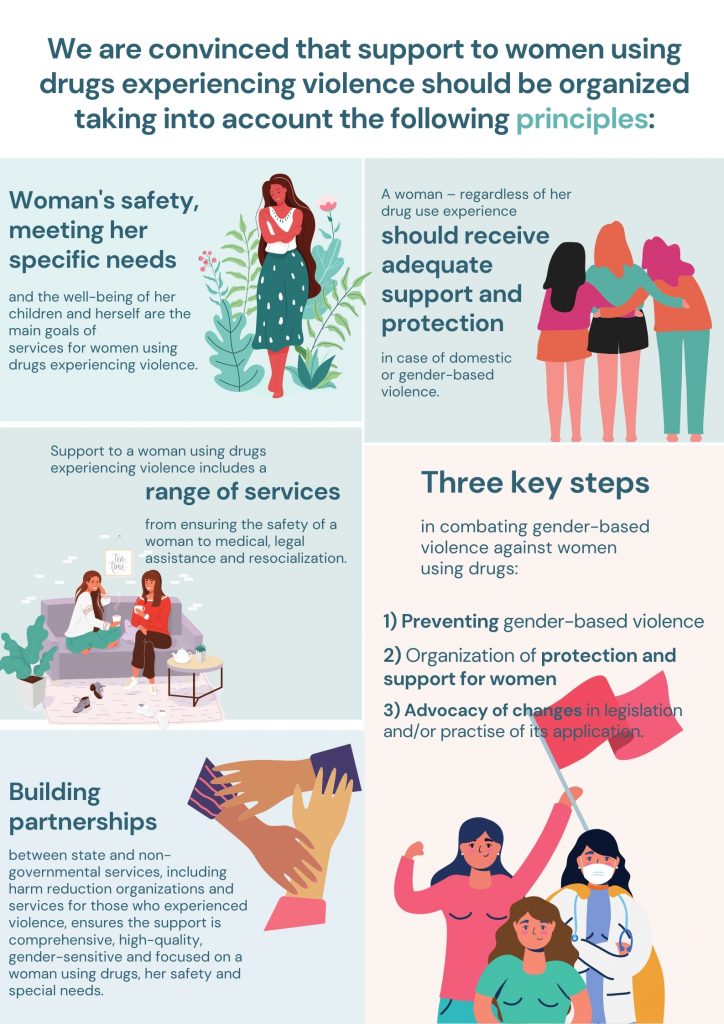
Realizing the particular vulnerability of women using drugs in a pandemic, in 2020 EHRA gathered fellow experts on providing assistance related to gender-based violence. Together we share the experience of successful integrated services, together we develop principles and practical approaches for organizing such support. We are convinced that support to women using drugs experiencing violence should be organized taking into account the following principles:

  • Woman’s safety, meeting her specific needs, and the well-being of her children and herself are the main goals of services for women using drugs experiencing violence.
  • A woman – regardless of her drug use experience – should receive adequate support and protection in case of domestic or gender-based violence.
  • Support to a woman using drugs experiencing violence includes a range of services from ensuring the safety of a woman to medical, legal assistance and resocialization.
  • Building partnerships between state and non-governmental services, including harm reduction organizations and services for those who experienced violence, ensures the support is comprehensive, high-quality, gender-sensitive and focused on a woman using drugs, her safety and special needs.
  • Three key steps in combating gender-based violence against women using drugs: 1 – Preventing gender-based violence; 2- Organization of protection and support for women; 3 – Advocacy of changes in legislation and/or practice of its application.

Our partners from 5 countries of the EECA region are building and piloting a system of support to women, which is coordinated with harm reduction programs. They provide daily counseling, referral to shelters and ensure safety, so necessary for women experiencing violence.

We believe that dreams come true

The story of a woman using drugs who experienced violence from Ukraine proves that our dream can come true. Here it is, listen:

“God, what a terrible word, “shelter”… However, I was so surprised when at 2 am they answered my call and offered to urgently come to them. There were no requirements for referral papers, health certificates, or statements to the police. A taxi was called for me and an hour later I was in a place that became close to me.

I needed help and I got it. The first thing they asked me was whether I wanted tea or coffee, or maybe I was hungry… ”. The story was provided by the EHRA partner organization “Convictus-Ukraine”.

We want every woman to get a chance not only to hide from violence for a short time, but also to find her calling and place in life, to gain independence, same as happened with the heroine of this story. Such words are all we need to get inspiration and continue work on improving access to shelters and psychosocial services for women using drugs experiencing violence. Our slogan:

Help, impossible to ignore!

More information about the project Access to comprehensive care for women using drugs in case of violence: https://old.harmreductioneurasia.org/projects/c19rm/.

EXTENDED: Terms of Reference for the EECA Regional Platform sub-regional Focal Points to help generating the CRG Technical Assistance Requests

Background

Since 2017 Eurasian Harm Reduction Association is being the host of the EECA regional Platform for Communication and Coordination. One of the EHRA responsibilities in its role as EECA Regional Platform is to promote the Global Fund’s Community, Rights and Gender (CRG) Technical Assistance Technical Assistance Program among civil society and communities’ representatives involved into the Global Fund related processes in EECA countries.

To better motivate and support CSOs and CBOs in the region to use the Technical Assistance (TA) available within this Program in 2021, EHRA is planning to sub-contract 4 experts to serve as the sub-regional EECA Regional Platform Focal Points aimed on generating the demand for the Global Fund’s CRG TA.

EHRA is looking for the experts to serve as the EECA Regional Platform Focal Points in the following 4 sub-regions: Central Asia (Kazakhstan, Kyrgyzstan, Tajikistan, Turkmenistan, Uzbekistan), Caucasus (Armenia, Azerbaijan, Georgia), the Balkans (Albania, Kosovo, Montenegro, Romania, Serbia) and 4th block – Belarus, Moldova, Russia, Ukraine.

Key tasks to be conducted by the consultants

Each expert selected to become the EECA Platform CRG TA Focal Point is expected to assist the civil society and communities’ representatives in relevant sub-regions in development and submission of at least 3 successful requests for the CRG TA per sub-region in 2021 (1 per quarter on average).

The CRG TA Request to be considered as successful if it is approved by the Global Fund’s CRG Department for TA provision.

In particular, the EECA Platform CRG TA Focal Points are expected to:

  • Initiate a dialogue with the civil society and communities’ representatives involved into the Global Fund related processes in each county of the selected sub-region about the opportunities available within the CRG TA Program.
  • Provide the civil society and communities’ representatives with all relevant information about the Global Fund CRG TA Program if needed.
  • Help the civil society and communities’ representatives to identify their needs for such TA, including identification of the potential problems which may need to be addressed, formulation of the objectives of such CRG TA in the context of the identified problems, as well as identification of the activities needed to be implemented as a part of the TA to address the identified problems and reach the set objectives.
  • Help to ensure the coordination of the content of the TA Requests among the key national civil society stakeholders, CCM and Fund Portfolio Manager before its submission.
  • Review the content of the draft TA Requests before the submission, help with its finalization if needed.
  • Help to follow up with the GF CRG Department on the results of the TA Request consideration.

Online training on the key aspects of the CRG TA Program will be provided for the selected consultants by EHRA at the beginning of March.

Also, the EECA Platform CRG TA Focal Points will be expected to do the mapping of the civil society and community-based organizations being the principal, sub and sub-sub-recipients of the Global Fund HIV and TB grants in all countries of the relevant sub-regions, where the Global Fund programs are implemented. The template Excel form for such mapping will be provided by EHRA.

Deliverables and Time frame

3 CRG TA Requests per each sub-region being developed, submitted with the support of the EECA Platform CRG TA Focal Point and approved for the TA provision by the Global Fund CRG Department in 2021.

Mapping of principal, sub and sub-sub-recipients of the Global Fund HIV and TB grants in the countries of relevant sub-regions conducted.

Cost of services and payment order

Payments will be done for each successful CRG TA request being generated with support of the EECA Platform CRG TA Focal Point – 700 USD per TA request (not more than 3 requests per sub-region altogether in 2021). Of this amount 350 USD will be paid after the fact of the submission of the TA request is confirmed, and other 350 USD will be paid after the request is accepted and approved for TA provision by Global Fund CRG Department. In case the TA request is rejected by Global Fund CRG Department – the second half of the 700 USD will not be paid to the Focal Point.

Also, 300 USD to be paid after the submission of the result of mapping of CSOs and CBOs – PRs, SRs and SSRs of the Global Fund grants in all countries of the relevant sub-region, where the Global Fund programs are implemented.

Payment should be executed for the completed services after receiving invoice and act of service rendered.

The total contract cost for the work of one consultant under this ToR in 2021 should not exceed 2 400 USD (including all taxes).

Evaluation Criteria

An evaluation panel will assess the extent to which proposals submitted in response to this announcement meet the evaluation criteria below.

The minimum technical score is 90. Only candidates with a minimum score of 90 points out of a maximum of 100 are considered eligible for the assignment. Consultants with proven work experience in the community organization would be given a priority.

The candidates with the highest technical score that meets the requirement will be invited for negotiation of the agreement.

CriteriaWeighting
Good understanding of the Global Fund CRG TA Program (should be clear from LoI)25 points
Knowledge of, and access to the relevant civil society stakeholders involved into the Global Fund related processes in the countries of the particular sub-region as well as established contacts with the GF Secretariat (regional team and CRG Department in particular) (should be clear from LoI)25 points
Experience of undertaking similar TA related assessments or other relevant work experience (should be clear from CV and LoI)25 points
Proven set of communication and writing skills (should be clear from LoI)25 points
Total100 points


Additionally, the consultants should have:

  • No conflict of interest (should be declared in the Letter of Interest);
  • Fluent English and language most relevant for the sub-region the expert is interested to work with.

How to apply

 The individual consultants are invited to submit their CV and the Letter of Interest (LoI) by e-mail referenced under title “EECA Platform CRG TA Focal Point for [name of the sub-region you are interested to work with]” to ivan@harmreductioneurasia.org by COB 18th of March 2021 24:00 EET.

EXTENDED: Terms of Reference for the consultant to document 2 successful cases of CRG Technical Assistance provision in EECA in 2019 – 2020

Background

Since 2017 Eurasian Harm Reduction Association is being the host of the EECA regional Platform for Communication and Coordination. One of the EHRA responsibilities in its role as EECA Regional Platform is to promote the Global Fund’s Community, Rights and Gender (CRG) Technical Assistance Technical Assistance Program among civil society and communities’ representatives involved into the Global Fund related processes in EECA countries.

To better inform and motivate CSOs and CBOs in the region to use the Technical Assistance (TA) available within this Program in 2021, EHRA is planning to document 2 successful cases of CRG TA provision in EECA.

EHRA is looking for the consultant to help with such documentation.

Key tasks to be conducted by the consultant

The consultant is expected:

  1. In consultation with colleagues from the Global Fund Secretariat CRG Department to help EHRA to identify two successful cases of CRG TA provision in EECA in 2019 – 2020 to be documented.
  2. To propose the format and structure of the case study to be developed as a result of the documentation.
  3. To collect all required information needed to document the selected two successful cases of CRG TA provision in EECA in 2019 – 2020. The methods of data collection should include:
    – the desk review of all documents (TA requests, ToRs for the TA providers as well as for the TA experts, TA budgets, final reports on the TA provision, documents resulted from the TA etc.) related to the provided TA;
    – the interviews with the representatives of the following key stakeholders: TA recipient, TA provider, GF CRG Department, experts involved into the TA provision, other national direct beneficiaries of the TA being provided (not less than 4 interviews per case).
  4. To develop two case studies describing the successful cases of CRG TA provision in 2 EECA countries in 2019 – 2020.

Deliverables:

Two documents presenting the description of two preselected successful cases of CRG TA provision in 2 EECA countries in 2019 – 2020.

The length of each document should not exceed 4 pages including the 1-page summary of the successful TA case.

The language of the resulted documents should be English or Russian (will depend on the countries where cases of TA provision to be documented).

Timeframe

  1. By 10th of March – to identify two successful cases of CRG TA provision in EECA in 2019 – 2020 to be documented.
  2. By 15th of March – to propose the format and structure of the final document to be developed.
  3. By 19th of March – to identify the key stakeholders to be interviewed and start data collection.
  4. By 1st of April – to provide EHRA with the draft case studies for a feedback and comments.
  5. By 9th of April – to provide EHRA with the final products.

Cost of services

 The total contract cost for the work of the consultant under this ToR should not exceed 1 500 USD (including all taxes).

Evaluation Criteria

An evaluation panel will assess the extent to which proposals submitted in response to this announcement meet the evaluation criteria below.

The minimum technical score is 90. Only candidates with a minimum score of 90 points out of a maximum of 100 are considered eligible for the assignment. Consultants with proven work experience in the community organization would be given a priority.

The candidates with the highest technical score that meets the requirement will be invited for negotiation of the agreement.

CriteriaWeighting
Good understanding of the Global Fund CRG TA Program (should be clear from LoI)25 points
Knowledge of, and access to, relevant stakeholders to be interviewed as well as to the other relevant sources of information (should be clear from LoI)25 points
Experience of undertaking similar assessments and a strong record of adherence to evidenced-based approaches (should be clear from CV and LoI)25 points
Proven set of skills for interviewing, conducting a literature review, and writing (should be clear from CV and LoI)25 points
Total100 points


Additionally, the consultants should have:

  • No conflict of interest (should be declared in the Letter of Interest);
  • Fluent English and Russian languages.

How to apply

The individual consultants are invited to submit their CV and the Letter of Interest (LoI) by e-mail referenced under title “Consultant to document 2 successful cases of CRG TA provision in EECA” to ivan@harmreductioneurasia.org by COB 5 of March 2021 24:00 EET.

Download this ToR

Educational podcasts to support work of paralegals are on air

To support the work of paralegals and guide them through algorithm of basic legal support provision to key populations in access to HIV services, EHRA jointly with HIV Legal Network have developed a series of podcasts. The key topics of podcasts: HIV cascade and human rights, instruments of paralegals, 7 steps in paralegals’ work, and peculiarities of work with different key populations groups.

The podcasts are available at EHRA educational platform in section of educational materials for paralegals in Russian (for access please register).

The podcasts were produced by EHRA within the project TIBERUIS: “Overcoming legal barriers for key populations – on the way to 90-90-90”. The project is aimed at improvement of the effectiveness of HIV continuum of care by overcoming legal barriers for the most vulnerable key populations in selected cities of Georgia, Kazakhstan and Moldova.


HERE you can find other EHRA’s educational materials on  protection of human rights and learn about our work n this field.

EXTENDED: Call for Consultancy to analyze the changes in the harm reduction packages and unit costs during transition from international to domestic funding in Ukraine, Moldova, North Macedonia and Kyrgyzstan

The Eurasian Harm Reduction Association is seeking a short-term national consultancy in Ukraine, Moldova, North Macedonia and Kyrgyzstan to analyze the changes in the harm reduction packages and unit costs during transition from international to domestic funding.

Background Information

Despite commitment by governments to continue HIV prevention among key groups, transition has significantly weakened community systems and interrupted services. Available packages and quality of harm reduction services are decreasing even if services are supported. Lack of political support for harm reduction, not only as an HIV prevention measure but as a social service, is one of the main obstacles to sustainable and sufficient funding for quality programmes.[1]

Since harm reduction (HR) programs have been first introduced in the countries the package of provided services changed and varies from country to country. Ukraine, Moldova, North Macedonia and Kyrgyzstan recently started funding the HR services from domestic resources through social-contracting and public procurement.

EHRA is looking for national consultants in Ukraine, Moldova, North Macedonia and Kyrgyzstan to analyze the changes in the harm reduction packages and unit costs during transition from international to government funding.

Objectives of the consultancy:

  • Analyze changes in unit cost per client, list/package of services since HR services were introduced in the country using secondary data (applications to the Global Fund to Fight AIDS, Tuberculosis and Malaria, budgets or target setting in national documents, national AIDS response strategies, standards/packages of services and/or national unit costs calculations, state procurement tenders and contracts with service providers);
  • Describe the rationale behind the changes in the package and/or unit costs (interviews with 2-3 key national informants involved in decision-making process)
  • Analyze the impact of occurred changes in unit costs and package of HR services on services provision, quality of provided services and client satisfaction with them ( interviews with services providers and community representatives/clients from different cities of the country).

Steps of the consultancy:

  1. Secondary data analysis
  2. Development of questionnaires in consultation with EHRA and national consultants from other 3 countries
  3. Interviews with key informants (the list of informants should be approved by EHRA)
  • 2-3 with national stakeholders involved indecision-making process regarding unit costs, standards and packages of services
  • 5 with harm reduction services providers from different cities of the country
  • 10 with clients of opioid substitution and needle and syringe programs
  1. Prepare draft analytical report based on the collected data
  2. Finalize the report based on EHRA’s feedback

Expected results of the consultancy:

  • Analytical report in Russian or English (up to 30 pages) on how the transition process affects harm reduction packages, unit costs and quality of provided services.
  • Suggested recommendations for donors and governments based on the analyzed data and interviews with key informants
  • Translation of the report into the national language

Proposed timeline: All tasks should be completed by May 31, 2021.

This call for proposals is organized within the  “Thinking outside the box: overcoming challenges in community advocacy for sustainable and high-quality HIV services” project of the Eurasian Regional Consortium financed by the Robert Carr civil society Networks Fund (RCF).

The Eurasian Regional Consortium joins the efforts of Eurasian Coalition on Health, Rights, Gender and Sexual Diversity (ECOM), Eurasian Women’s AIDS Network (EWNA) and Eurasian Harm Reduction Association (EHRA) to effectively address the lack of financial sustainability in prevention, treatment, care and support programs for the key populations vulnerable in terms of their rights violation and the risk of HIV.

Selection criteria:

The submitted applications will be evaluated by the selection committee of the Eurasian Harm Reduction Association. The following criteria will be used to evaluate the bids (the maximum possible number of points is 100):

  • Knowledge and understanding of GF funding and national procurement procedures (25 points)
  • Clear understanding of situation with harm reduction funding in the country (25 points)
  • Relevant work experience (analytical reports) (20 points)
  • Established connections with service providers (15 points)
  • Experience in monitoring and evaluation (10 points)
  • Fluent Russian or English (5 points)

EHRA will consider for the contract only applicants that scored at least 80 points out of 100.

This announcement shall not be construed as a contract or a commitment of any kind. This request for proposals in no way obligates EHRA to award a contract, nor does it commit EHRA to pay any cost incurred in the preparation and submission of the proposals.

Terms of payment and other conditions same as a final timeline will be indicated in the agreement which EHRA will sign with the winner.

How to apply

Applicants must submit the following documents to maria@harmreductioneurasia.org, the subject of the letter is “Call UC”,the deadline for submission is before 24:00 EET on March 24, 2021:

  1. CV
  2. Letter of interest with suggested consultancy fee (USD) and number of working days (8 hours/day)
  3. List of potential respondents from organizations providing harm reduction services

[1] https://www.hri.global/files/2020/10/26/Global_State_HRI_2020_2_2_Eurasia_FA_WEB.pdf

Terms of Reference for the EECA Regional Platform sub-regional Focal Points to help generating the CRG Technical Assistance Requests

Background

Since 2017 Eurasian Harm Reduction Association is being the host of the EECA regional Platform for Communication and Coordination. One of the EHRA responsibilities in its role as EECA Regional Platform is to promote the Global Fund’s Community, Rights and Gender (CRG) Technical Assistance Technical Assistance Program among civil society and communities’ representatives involved into the Global Fund related processes in EECA countries.

To better motivate and support CSOs and CBOs in the region to use the Technical Assistance (TA) available within this Program in 2021, EHRA is planning to sub-contract 4 experts to serve as the sub-regional EECA Regional Platform Focal Points aimed on generating the demand for the Global Fund’s CRG TA.

EHRA is looking for the experts to serve as the EECA Regional Platform Focal Points in the following 4 sub-regions: Central Asia (Kazakhstan, Kyrgyzstan, Tajikistan, Turkmenistan, Uzbekistan), Caucasus (Armenia, Azerbaijan, Georgia), the Balkans (Albania, Kosovo, Montenegro, Romania, Serbia) and 4th block – Belarus, Moldova, Russia, Ukraine.

Key tasks to be conducted by the consultants

Each expert selected to become the EECA Platform CRG TA Focal Point is expected to assist the civil society and communities’ representatives in relevant sub-regions in development and submission of at least 3 successful requests for the CRG TA per sub-region in 2021 (1 per quarter on average).

The CRG TA Request to be considered as successful if it is approved by the Global Fund’s CRG Department for TA provision.

In particular, the EECA Platform CRG TA Focal Points are expected to:

  • Initiate a dialogue with the civil society and communities’ representatives involved into the Global Fund related processes in each county of the selected sub-region about the opportunities available within the CRG TA Program.
  • Provide the civil society and communities’ representatives with all relevant information about the Global Fund CRG TA Program if needed.
  • Help the civil society and communities’ representatives to identify their needs for such TA, including identification of the potential problems which may need to be addressed, formulation of the objectives of such CRG TA in the context of the identified problems, as well as identification of the activities needed to be implemented as a part of the TA to address the identified problems and reach the set objectives.
  • Help to ensure the coordination of the content of the TA Requests among the key national civil society stakeholders, CCM and Fund Portfolio Manager before its submission.
  • Review the content of the draft TA Requests before the submission, help with its finalization if needed.
  • Help to follow up with the GF CRG Department on the results of the TA Request consideration.

Online training on the key aspects of the CRG TA Program will be provided for the selected consultants by EHRA at the beginning of March.

Also, the EECA Platform CRG TA Focal Points will be expected to do the mapping of the civil society and community-based organizations being the principal, sub and sub-sub-recipients of the Global Fund HIV and TB grants in all countries of the relevant sub-regions, where the Global Fund programs are implemented. The template Excel form for such mapping will be provided by EHRA.

Deliverables and Time frame

3 CRG TA Requests per each sub-region being developed, submitted with the support of the EECA Platform CRG TA Focal Point and approved for the TA provision by the Global Fund CRG Department in 2021.

Mapping of principal, sub and sub-sub-recipients of the Global Fund HIV and TB grants in the countries of relevant sub-regions conducted.

Cost of services and payment order

Payments will be done for each successful CRG TA request being generated with support of the EECA Platform CRG TA Focal Point – 700 USD per TA request (not more than 3 requests per sub-region altogether in 2021). Of this amount 350 USD will be paid after the fact of the submission of the TA request is confirmed, and other 350 USD will be paid after the request is accepted and approved for TA provision by Global Fund CRG Department. In case the TA request is rejected by Global Fund CRG Department – the second half of the 700 USD will not be paid to the Focal Point.

Also, 300 USD to be paid after the submission of the result of mapping of CSOs and CBOs – PRs, SRs and SSRs of the Global Fund grants in all countries of the relevant sub-region, where the Global Fund programs are implemented.

Payment should be executed for the completed services after receiving invoice and act of service rendered.

The total contract cost for the work of one consultant under this ToR in 2021 should not exceed 2 400 USD (including all taxes).

Evaluation Criteria

An evaluation panel will assess the extent to which proposals submitted in response to this announcement meet the evaluation criteria below.

The minimum technical score is 90. Only candidates with a minimum score of 90 points out of a maximum of 100 are considered eligible for the assignment. Consultants with proven work experience in the community organization would be given a priority.

The candidates with the highest technical score that meets the requirement will be invited for negotiation of the agreement.

CriteriaWeighting
Good understanding of the Global Fund CRG TA Program (should be clear from LoI)25 points
Knowledge of, and access to the relevant civil society stakeholders involved into the Global Fund related processes in the countries of the particular sub-region as well as established contacts with the GF Secretariat (regional team and CRG Department in particular) (should be clear from LoI)25 points
Experience of undertaking similar TA related assessments or other relevant work experience (should be clear from CV and LoI)25 points
Proven set of communication and writing skills (should be clear from LoI)25 points
Total100 points


Additionally, the consultants should have:

  • No conflict of interest (should be declared in the Letter of Interest);
  • Fluent English and language most relevant for the sub-region the expert is interested to work with.

How to apply

 The individual consultants are invited to submit their CV and the Letter of Interest (LoI) by e-mail referenced under title “EECA Platform CRG TA Focal Point for [name of the sub-region you are interested to work with]” to ivan@harmreductioneurasia.org by COB 1st of March 2021 24:00 EET.

Download this ToR