Sustainability and integration of HIV and TB services for vulnerable people in Europe is in focus

Author: Yuliia Holub

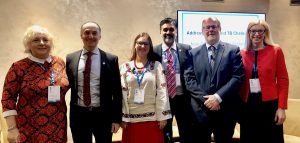
In 2014, WHO diagnosed in European region 80% more new HIV cases than ten years earlier. The Eastern part of the region has the fastest growing HIV data and the second lowest treatment access in the world. As well as the highest rates of the global multidrug-resistant tuberculosis (MDR-TB) (about 20%) and drug resistance among treated TB cases. Having emerging HIV and TB situation in European countries, problem of sustainable funding of the response. In the response of the transitioning to domestic funding of the HIV and TB services in European region and accenting attention on the possibilities integrate them in universal health coverage , on 12-13 December 2017, the Estonian Presidency of the Council of the European Union is launching a high-level dialogue – “Addressing HIV and TB Challenges: from Donor Support to Sustainable Health Systems”.

During the two-day event, representatives of international and state institutions, civil society, NGOs, technical agencies and donors will discuss current challenges and opportunities in the European Union and neighboring countries for successful integrating TB and HIV services into national and European health systems. Besides, the participants will get possibility discuss practical and effective access to health care, especially for key affected populations.

Being involved in the organising the event, Eurasian harm reduction association is keen to discuss burning issues of the sustainable domestic funding for harm reduction services and its integration into health and social care systems with high level decision makers, regional experts and colleagues from regional community networks.

“In fact we already know what need to be done for effective response on HIV and TB among people using drugs. All standards are developed, trained social workers are in place. We do have money. Unfortunately millions of taxpayer resources are spend now for caching drug users by police and keeping them in prison, which only cause social and health problems but not solving anything. So where is the key obstacle for being effective in epidemic response? In political will, but more correctly – in political sabotage. With several miracle exceptions, decision makers do not hear our arguments for effective programs.

But we will not stop our pushing for prioritisation of services for communities. We need to mobilise communities on municipal and city level for active advocacy for the sustainable services” – says on the first plenary of the meeting Anna Dovbakh, the Executive Director of Eurasian Harm Reduction Association.

In the result of the meeting “Addressing HIV and TB Challenges: from Donor Support to Sustainable Health Systems” there will be outcome document with recommendations on integration of HIV and TB response in national health systems especially focused on sustainable financing of services for vulnerable groups in European Union and neighboring countries.
Regional Platform for Communication and Coordination begins its work in EECA region as part of the Global Fund’s CRG Strategic Initiative

Author: Yuliia Holub

Eurasian Harm Reduction Association was selected as a New Host of the Regional civil society and community coordination and communication Platform in Eastern Europe and Central Asia. 

The Regional Platforms for Communication and Coordination were established in 6 regions of the world by the Global Fund within its Community, Rights and Gender Special Initiative (CRG-SI) which was implemented throughout 2014-2016. In November 2016 the Global Fund Board approved $ 15 million to continue with the implementation of the CRG SI throughout the 2017-2019 funding cycle. As before CRG SI will be implemented via three mutually reinforcing components: (1) Short-Term Technical Assistance Program, (2) Long-Term Capacity Development and Meaningful Engagement of Key and Vulnerable Populations and (3) the Regional Platforms for Communication and Coordination. At the end of 2017 six civil society organizations were selected by the Global Fund to host the platforms and the region of Eastern Europe and Central Asia (EECA) has got a new host: the Eurasian Harm Reduction Association (EHRA).

The regional platforms for communication and coordination are expected to have a key role in engaging civil society organizations and community networks in Global Fund processes. They are responsible to foster regional dialogue, exchange knowledge and good practices among civil society actors and networks, as well as to disseminating information on technical assistance opportunities across civil society and community groups across all countries where the Global Fund has grants and/or countries under Global Fund multi-country grants.

To progress towards these goals, during the next 2,5 years the EHRA in its role as a regional platform will be aiming to achieve the following objectives in EECA region:

Objective 1. Further the meaningful engagement of civil society and community groups through regular bi-directional communication and provision of accurate and accessible information to enhance the knowledge and participation of these actors in Global Fund related processes.

Objective 2. Improve the overall impact of Global Fund programs and interventions, and disease responses more globally through strengthened engagement of civil society and communities affected by HIV, tuberculosis and malaria.

Objective 3. Expand access to technical assistance for civil society and community groups through greater coordination with the CRG Strategic Initiative short-term TA component, as well as key national, regional and global technical assistance partners.

Objective 4. Support strategic civil society and community capacity development initiatives through fostering spaces for engagement and collective participation in key decision-making processes, in particular as they relate to community, rights and gender.

More specifically the EECA Regional Platform activities in next 2.5 years will include a number of national workshops for civil society and community organizations involved into the implementation of the Global Fund grants as sub-recipients or sub-sub-recipients; regional workshop for CCM members from EECA countries – representatives of civil society sector; support for NGOs and CBOs in development of the quality TA requests for the CRG Technical Assistance; improvement of access to the Global Fund related information through webinars, info notes, coordination calls; and other activities.

“Meaningful involvement of communities and civil society into the Global Fund related processes in the region, especially those focused on transition to national funding of services –  is crucial to guarantee that those components of HIV\TB response of a high priority for KAPs are not lost within the transition and their sustainability is ensured”, says Anna Dovbakh, the Executive Director of the Eurasian Harm Reduction Association. “As a hosting organization of the EECA Regional Platform we will work to help community leaders to become key actors in the process of effective transitioning in the region”.

 Within the implementation of this project EHRA is planning to work closely with other key regional organizations and community networks in EECA. In particular EHRA will be aiming to develop a closer communication and cooperation with those organizations being selected as CRG Technical Support Providers in the region to allow timely provision of peer-to-peer technical assistance on human rights, gender, community systems strengthening.

You may follow us on a Platform’s Facebook Page as well as join the EECA Regional Platform Facebook group. The Web-site of the Regional Platform will be re-launched soon, and this will be announced separately.

Any questions regarding the work of the Regional Platform or how to apply for the Global Fund’s Community, Rights and Gender Technical Assistance you may address to Ivan Varentsov, EHRA Sustainability & Transition Advisor: eecaplatform@harmreductioneurasia.org 

EHRA announces Regional meeting to elect Steering Committee members

Eurasian Harm Reduction Association (EHRA) announces the convocation of the members’ meetings from the particular regions: Baltic states, Central Europe, South-Eastern Europe, Belarus-Ukraine-Moldova and Central Asia.

We invite all EHRA members from the above-mentioned regions to submit applications to become a member of the Steering Committee until 1 January 2018.

A list of Steering Committee members subject to rotation:

1. Agita Seja (Baltic states)

2. Peter Sarosi (Central Europe)

3. Yuliya Georgieva (South-Eastern Europe)

4. Liudmila Trukhan (Belarus-Ukraine-Moldova)

5. Aibar Sultangaziev (Central Asia)

Candidates should:

  1. Be a member of EHRA.
  2. Demonstrate readiness and ability to work responsibly and actively as a Steering Committee member.
  3. To reside within a region participating in the current elections.
  4. To avoid a potential conflict of interests, candidates cannot be representatives of Association’s donor organizations.

From 10 to 24 January, 2018 will be online voting to elect Steering Committee members in these five regions. And 25 January, 2018 EHRA will announce results.

If you have any questions, please address to Secretary of the Regional meetings Eliza Kurcevic, on e-mail: members@harmreductioneurasia.org